

Books and Libraries
Hidden histories in the world of words

Hello,
Welcome (back), and happy Friday wherever you are. I’m currently in Istanbul at about the mid-point of a fixed-term job that involves pretty much living in a library. (Technically, there is a corridor between my room and the library but the walls are made of glass, so it feels pretty close!)
I’m enjoying working on research projects new and old and spending time on something I love nearly as much as history: languages. I’m learning Turkish and loving the way that the language unlocks new parts of the world around me every day. I’m also practicing and improving languages I’ve studied for longer, including my great linguistic love, Tamil. And I’m starting to study Hindi and Telugu in preparation for moving to Andhra Pradesh (southeast India) in July.
Languages fascinate me: the way they sound, how they are written and the ways they reflect and create societies. They also carry layers of history with them. So, let me start with something I noticed and then peel back some layers. They take us back to how societies imagined the very stuff of books and writing as well as through journeys of meeting and sharing at the interface of different languages.
Books in a Library?
In English, saying that 'books belong in a library’ mixes two different language streams. English is, for the most part, a combination of ‘Germanic’ language (which gives it most of its grammar) and ‘Romance’ influences (mainly Latin and Old French), which give it a lot of vocabulary. This combination has its own history relating to medieval migrations, conquests, church policies and changing fashions. It is also not the whole story: there are elements in English that come from all sorts of other languages too. From Welsh to Hebrew to Hindi and Russian, words borrowed from other languages are like fragments of memory - glimpses into meetings and relationships, the sudden rupture of conflict and the slow, messy processes of peace making.
Linguists talk about languages belonging to families. These are groups of languages with
a) similar grammatical patterns (for example, when you say ‘the dog bit the man’, who do you think bit whom? In English, the one doing the biting goes before the verb (to bite) and the one being bitten goes after the verb, but in Hindi it is the other way around, so that dog had better watch out!)
and…
b) similar words for things. So, in English, ‘one, two, three’ look and sound a bit similar to German ‘eins, zwei, drei’, or French ‘un, deux, trois’ or even Russian (odEEn, dva, tree) and Hindi (ek, doh, teen), as these languages are all related to each other (some more closely than others), but they look and sound nothing at all like either Turkish (bir, iki, üç) or Tamil (ondru, irandu, moondru), which are both from different language families (including from each other).
Like human families, languages have generations, ancestors and close and more distant relations. Languages change over time and across space. Unlike human families, though, there aren’t hard lines between different languages. You may look a lot like your brother or cousin or mother, but you are definitely all different people! The boundaries between languages are much more fluid. Changes happen slowly, as people’s pronunciation slowly changes across generations or people speaking the same language but hundreds of miles apart start using expressions that at first might be ‘wrong’ and then become ‘normal’ and eventually might become ‘correct’ in a completely new language. That can and does happen even within the same language or family, but languages also borrow from one another.
And that brings us back to books and libraries. ‘Book’ in English comes from a Germanic ancestor language, which is why it is pretty similar to the word for book in other languages that share that ancestor (for example, ‘Buch’ in German or ‘Bog’ in Danish). This word is believed to derive from the word for ‘beech’, as in a kind of tree with a pale bark that can be peeled off in strips or ‘tiles’ and on which graffiti (made directly onto the tree) is very visible. So, whether people way-back-when scratched things into beech trees or peeled off bits of beech bark and wrote on it, or both, the word ‘book’ gives us a clue to what how people in northwestern Europe first saw the process of writing as a part of their phsical world.

So much for ‘book. ‘Library’, though, is a bit different. It is from the Latin word for book: ‘librum’. This also originally meant the inner bark of a tree. So here we see people speaking languages that are really quite far apart (in the same mega-family, along with things like Hindi and Russian, but definitely distant cousins we’ve vaguely heard about rather than people we see at every family wedding): both chose to write on the bark of trees and that became part of their language for things that carry writing. Over centuries, ‘librum’ gave us the word for ‘book’ in a whole load of languages which have Latin as their ancestor (e.g. ‘Livre’ in French, ‘Llibre’ in Catalan or ‘Libro’ in Italian).
In Britain, even though the word for ‘book’ was Germanic, books were expensive so having collections of them was something mostly associated with churches, where Latin was the everyday language of business, or with royal and aristocratic courts which often used early forms of French as their elite language. Hence, ‘books’ (Germanic) got put into ‘libraries’ (Romance).
Journeys of Sound
It turns out that ‘books’ and ‘libraries’ don’t match in other languages, too, and this was the thing I noticed in my Turkish class a little while ago. In Tamil, I already knew that a ‘pusthagam’ (book), is usually found in a ‘noolagam’ (library). And I sort of knew that that was because a ‘noolagam’ came from an older form of Tamil, while ‘pustagam’ came from Sanskrit, the ancestor language of a large number of languages spoken further north in India than Tamil, and from a different family. (Sanskrit, like Latin, is also still used as a religious language.)
Then, I started learning Hindi and I found another such oddity. In Hindi, you find a ‘kitap’ (book) in a ‘pusthakaalaay’ (library). Hopefully, you can see that ‘pusthakaalaay’ is related to ‘pusthagam’. That makes sense because Sanskrit is the ancestor language of Hindi, so a pusthakaalaay should be where you find a collection of pusthagam(s). (I’m going to use the English plural (s) on words in all languages, in a bracket because that isn’t how most of them make things plural, but… if we start talking about how each of these languages makes things plural AS WELL we could be here a while…)
But you don’t (mostly) find pusthagam(s) in pusthakaalaay(s).1 You find kitap(s). What gives?
Turkish provides some of the answer. The word for a book in Turkish is ‘kitap’, too. (And books in Türkiye are kept in a kütüphane, so the words for book and library are related. A kütüphane is literally a book hostel, which I think is delightful.) But why would Hindi and Turkish have the same word for book? The answer is… Arabic… probably via Persian. And now the only way is history!
But first let’s get our evidence pile together:
In Tamil, mostly and originally spoken in southern peninsular India, you keep a pusthagam (originally from Sanskrit) in a noolagam (originally from Old Tamil).
In Hindi, mostly spoken in nortth-central India, you keep a kitap (from Arabic originally but probably introduced from Persian) in a pusthakaalaay (from Sanskrit, pusthagam)
In Turkish you keep a kitab in a kütüphane (both from Arabic but what is the connection with Hindi?)
Swap and Borrow
People borrow words from other languages for all sorts of reasons:
Maybe they don’t have the thing the other language describes, so when they get the thing, the label comes with it. I’ve written here about some of the history of coffee in Europe. The word ‘coffee’ comes to English from the Turkish ‘kahve’, because the name and the delicious, caffeinated wonder-beverage travelled together from Istanbul.
Maybe, when two languages meet, because of migration, and each have a word for the same thing, they keep both words but give them each a slightly different purpose. This can relate to the different social roles or political power of speakers of each language. In English, words for animals often come from the Germanic word, which would have been used before 1066 (e.g. cow, pig, sheep). Then, in 1066, the Norman Duke William won the Battle of Hastings and became King William I. He brought with him a new aristocracy of Normans, who spoke of an early form of French (a Romance language). As the new upper-crust of society, these were the people who ate fancy food, which peasants and servants who would have spoken the Old English (a Germanic language), farmed and cooked for them. As a result, the words for the meat of those same animals comes from the Romance words that the Norman lords would have used to tell their new servants what they wanted for dinner (beef, pork, mutton).

Maybe societies use one language for ‘fancy’ settings (like royal or aristocract courts), for spiritual settings (like religious ceremonies or organisations), or for educational settings (like schools and universities), and another (or many others) in ‘everyday’ life. This can happen as a result of conquests, like the introduction of Norman French in England after 1066, but it can also be a way for people to signal membership, display education or show cultural affinity with somewhere they see as more powerful, sophisticated or fashionable. Russian aristocracts in the 19th century mostly spoke French to each other because it was considered more glamourous and ‘civilised’ than Russian, let alone the many other minority languages spoken across the empire. Across most of Europe until the early 20th century, anybody joining a university was expected to read and write Latin. It marked people as educated but also made international communication easier. If you watch Bollywood movies today, the trendy, young, urban characters will often speak Hindi with lots of English words and phrases, reflecting (and sometimes poking fun at) city-living, up-market fashions. Since people in these ‘special’ positions are also members of the society as a whole, language choices don’t stay sealed away from each other in their neat little social boxes. French words got into Russian (and Russian words into the French spoken in Moscow and St Petersburg), Latin got out into European languages from the church and universities, English and Hindi in India swap words and phrases back and forth.
Often, it is impossible to say exactly when or why one particular word gets borrowed and it would never have been one decision anyway. Ths isn’t a matter of policy. It is about habits and trends. Still, we can point to situations that made swaps and adoptions more likely. In English, as we’ve seen, the victory of William of Normandy in 1066, and then a few centuries of Norman French being used as an aristocratic language, set the stage for certain kinds of linguistic exchange.
If we look in the same way at our books and libraries, the stage setting looks something like this…
Once upon a time, speakers of three different languages came up with (or borrowed!) words for ‘an object that is made out of stuff with lots writing on it’. Each of these languages imagined these objects slightly differently, focussing on different aspects of their material reality. And, indeed, some of these objects were materially different: made of different things, shaped differently and read in different ways.
In Semitic lanuguages, which is the family that Arabic belongs to, core ideas are often expressed through three-letter consonant clusters. Changing the order of those consonants, adding suffixes and prefixes or putting different vowels in between them, creates different, but connected, words. K-T-B is the three-letter cluster associated with things to do with words and writing, so KiTaB is a book, but KaTiB is a (male) writer and maKTuB is a letter (the sort kids write to Santa, not ‘letter’ as in ABC). So, the Arabic word for ‘book’ focuses on the writing that can be found there. (The ‘b’ becomes a ‘p’ in Turkish and Hindi because b>p, especially at the end of words is one of those gradual changes that happens a lot as people’s pronunciation changes over time.)
In Sanskrit, people borrowed a word from yet another language family (Middle Iranian). The word ‘pust’ meant leather or skin and another related term, ‘pavásta’ meant covering, so in the case of ‘pusthagam’, people seemed to have focussed on the outer covering of the object with the writing in it, in order to give that object a label.
In Tamil, the word ‘nool’ means thread but it also came to mean ‘book’. Writing in peninsular South Asia was usually done on strips of palm leaf, which were then stitched together, so here, people named the object with writing on it after the way it was put together.
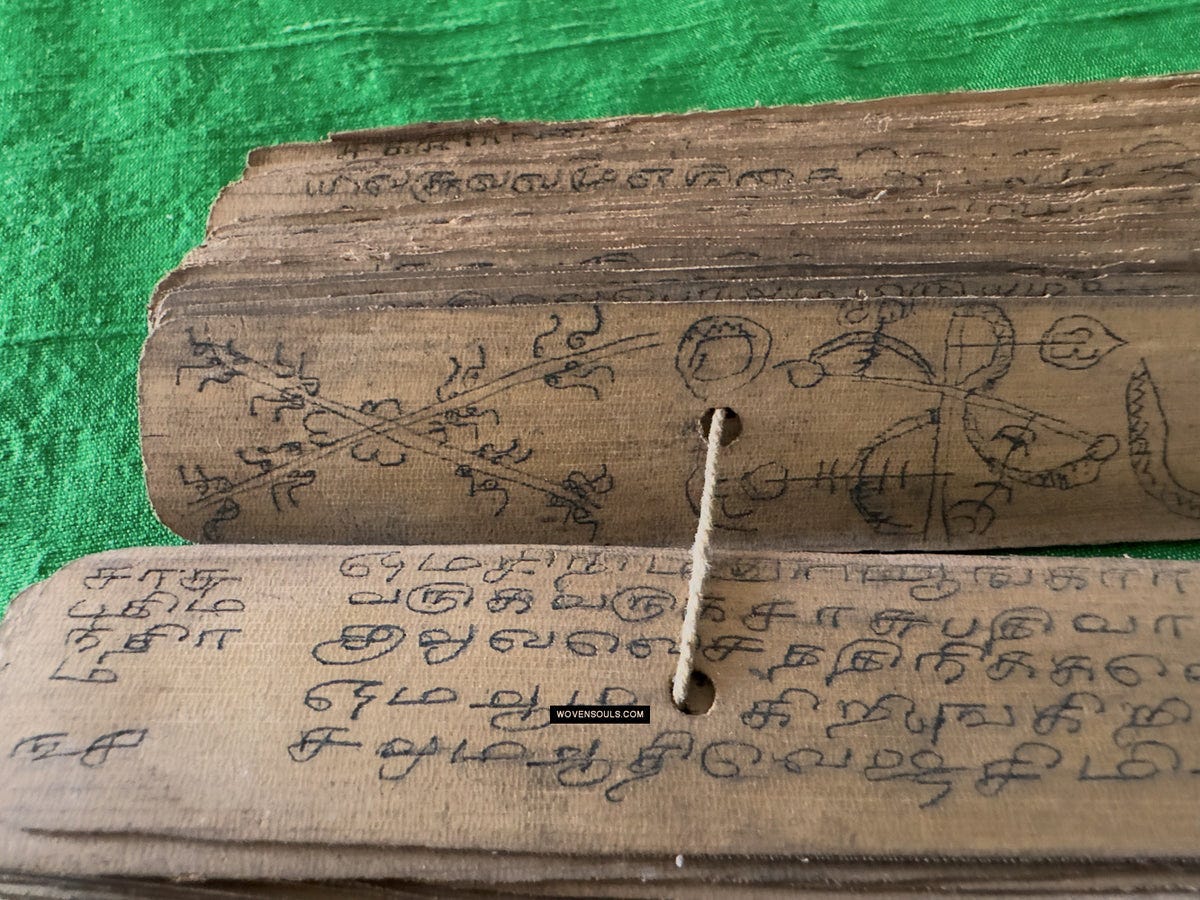
All of this was well-established by the start of the first millennium CE (my favourite millennium!). Each of these words (kitab, pusthagam, nool) existed and was used by cultures that produced long-form, handwritten texts. We might reasonably call these objects ‘books’, even if we know that they did not all look the same. And all of these cultures had collections of books, often associated with royal and religious centres.
In the first millennium, interactions across two different linguistic frontiers played a central role in the naming of books and libraries across space. They took place over centuries, and were happening simultaneously, so I’ll just describe them moving from north to south.
Northern India
In the seventh century, Islam emerged onto the world stage as both a religion and a political system. The Caliphate expanded rapidly and ended up taking control of territory from the Atlantic coast to south of the Himalaya. Shortly afterwards, this enormous territory broke up but even though lots of different political units popped up, Islam and elements of a shared culture remained, becoming stronger over time and blending with local and regional cultures that had been there before. One place where this blending was particularly important was in the region of modern Iran. Here, there was an existing culture, rooted in Persian language (a different language family to Arabic!) and connected with the rich and powerful Sasanian Empire, which the Caliphate had taken over.
So-called Middle Persian, an ancestor of modern Farsi, had been the language of government and literature. Incoming Arabic speakers both needed and admired speakers and writers of Persian: they often remained in bureaucratic positions and Persian remained the language of administration for generations before Arabic took over. Persian literature and songs became popular and reading and writing Persian as well as Arabic became a mark of education and sophistication. The Arabic word ‘kitab’ became the word for ‘book’ in both Arabic and in new forms of Persian (in modern Persian it is ketab): both languages in this environment swapped with one another and borrowed words.
Meanwhile, from the ninth century onwards, various different Muslim states (or states where Islam was becoming the dominant religion) came into contact with Hindu states in India. This included warfare and conquest, trade and diplomatic relations. Parts of the north of what is now India, as well as modern Pakistan, were for centuries ruled by Muslim elites who shared in the wider fashion for Persian language and culture. Courtiers, poets, artists and religious scholars frequently spoke and wrote in a Persian heavily influenced by Arabic, or, in other cases, in Arabic heavily influenced by Persian, as well as in Sanskrit and other South Asian languages. It was in this context that kitab(s) came to be stored in pusthakaalaay(s), combining Arabic and Sanskrit language.
Southern India
While Arabic, Persian and Sanskrit (and languages related to Sanskrit) were meeting in northern South Asia, further south, another linguistic frontier was also a place of connection and combination. In the south of India is a family of languages, called ‘Dravidian’, of which Tamil is one. They are very different from the Sanskrit-related languages further north. These two language families are very different, but they also have a long relationship.
Especially in the first millennium CE, new kingdoms were rising, falling and competing across the south of India (just as they were further north!) and in their competitions with each other, social and economic factors were as important as pure military might. Strategies were used to differentiate rulers from those they ruled and from other neighbouring rulers. Conversely, kings and emperors might associate themselves with others who seemed like powerful models or allies. These were all ways to project power. Attracting administrators from larger states or places with more complex bureaucracies could helped to manage resources better.
Sanskrit was an important tool in all of this power play. Some kings and emperors put up stone inscriptions in both Sanskrit and their local Dravidian language(s). Many encouraged groups of learned religious elites, often from further north, to move south, supported by grants of land. In return, these migrants would be administrators but, above all, performers of religious rituals which were usually performed in Sanskrit. So here, too, languages met and mingled in environents of conflict and power but also everyday interactions and gradual, unofficial processes of accommodation. And somewhere amidst all of that, nool(s) became pusthagam(s).
Pusthagam(s) are still kept in noolagam(s), though, preserving the older word (which is now also sometimes used specifically to mean palm leaf manuscripts, rather than books in other forms). Possibly, this is because, like putting kitab(s) in pusthakaalaay(s), languages don’t care about keeping things logical or consistent: they are living systems full of serendipity, accident and opportunistm, and noolagam survived as the term for library, while nool dropped (mostly) out of use to mean book. Or possibly noolagam is actually a much newer word, created or popularised as part of very recent moves, especially in the 19th and 20th centuries, to replace ‘foreign’ borrowings in Tamil. If so, then that too is part of the story of how languages grow and change. But whenever it happened and why exactly it got that way, pusthagam/noolagam is another fascinating glimpse into the switching and swapping that every language and every meeting of languages makes possible.
So, there you go! A fast-paced romp across time and space, from conquests to cosmopolitanism, stitched leaves to leather wraps and a world of words! And isn’t that the magic books and libraries?
Actually, there are several words that can be used to mean ‘book’ in Hindi, but kitap seems to be the most common one.
Fascinating! During two recent visits to Iceland (and follow up reading), I learned the Icelandic people and government actively preserve their isolated language, which is closely descended from Old Norse. Icelandic speakers can read Old Norse manuscripts with only a little help.
When new words are needed, for example for “computer,” they agree on a combination of existing Icelandic words and avoid allowing the English word to be adopted. The result was the Icelandic word Tolva, or “number phrophetess,” using a word that harkens back to the pagan “völva,“ who were the (mostly) female seeresses who could help Germanic and Viking societies predict the future or make decisions (eg, one of them in Germania indicated when it was a good time to attack Roman legions).
Icelandic speakers even brought back letters that were beginning to fade! The letters ð and þ were fading, (they had long before disappeared from English and other Germanic languages; they were present 1,000 + years ago in Old English and Old Norse). Now they are firmly embedded again in Icelandic.
I love that!