

Buddha from Berenike
Points of connection in a sea of diversity

Hello,
Welcome and I hope you’re well. From a wet Friday (at least in Istanbul), let me bring you a treat or two from warmer climes. They each tell a story of their own but they all fit together, too, into a re-thinking of the way we think about the world. They come from an archaeological site on the western coast of the Red Sea, in Egypt.
The name of this site in the first millennia BCE and CE was ‘Berenike’ or ‘Berenike Troglodytica’. Berenike was a queen of the Ptolemies, a dynasty that ruled in Egypt from the 4th century BCE. ‘Troglodytica’ refers to the idea that urbanites in Alexandria had of the faraway shores of the Red Sea, as a rustic area where people (‘Troglodytai’, or ‘cave dwellers’) lived in caves rather than houses.
It was one of the southernmost ports used in the first millennium CE to connect the Roman Empire with trade routes to the Western Indian Ocean. The Romans had taken over Egypt from the Ptolemies in the 1st century BCE, and access to the huge market of the Roman Mediterranean quickly encouraged trade in spices, textiles, live animals and pretty much anything else that Roman consumers might be able to get their hands on from ‘India’ (which to them meant all of modern South Asia). Berenike continued in use until the 6th century CE, when it declined and fell out of use, probably because of both a decline in trade and because its harbour silted up - a natural process that took a lot of effort to resist in a time without mechanical dredgers!
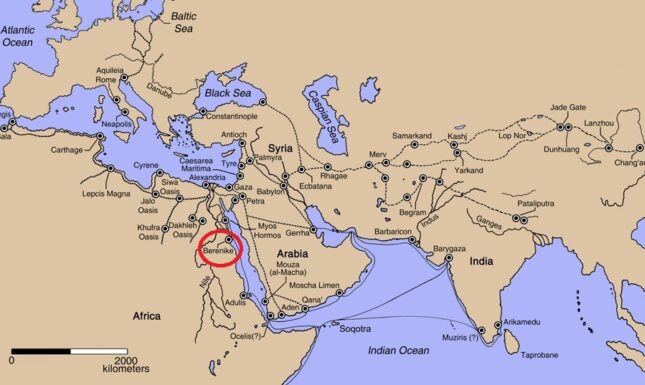
Three things make Berenike a great resource for historians. The first is that 6th-century abandonment. It was probably pretty bad for people who had built businesses on bringing goods into Berenike and shipping them on up to the Mediterranean on boats on the Nile or the backs of camels. But for us, it means that what got left behind stayed pretty much where it was left. It wasn’t built on over and over and over, as happens in big cities that have been inhabited for centuries. And Berenike isn’t really near to anything else, so it wasn’t even worth people raiding the buildings for stone or other materials to reuse.
The second is the hot, dry climate along the Red Sea coast. It is great not just for the survival of stone but of wood, seeds, cloth, and indeed, gypsum. Egypt is such an incredible place and its ancient societies were remarkable on their own terms, but we can see that so vividly because the Egyptian climate is also fantastic for preservation.
The third factor that makes Berenike a superstar site is the commitment and painstaking work by teams from the universities of Delaware and Warsaw. Berenike was excavated from 1994 to 2001. Then excavations began again from 2007 and continue today. Just the logistics of excavations lasting more than 25 years, in a pretty inhospitable place, are mind-boggling: imagine everything from ensuring water, food, toilets, accommodation for diggers; housing for artefacts; transportation for everybody to the site; and raising funding for it all! Even more remarkable, those excavations have been consistently, excellently and promptly published. In the world of archaeology, this combination of a great site (in terms of having interesting stuff), with great preservation, and a great record of publication is a bit like meeting a millionnaire paediatric surgeon with a heart of gold and a great sense of humour on a dating app.
Specialists working on Berenike have examined food remains, fragments of sails and clothing, the design of buildings, types of cookware and kitchen tools and even a pet cemetery. And among the many things they have uncovered, there was, in the 2018/19 season, this:
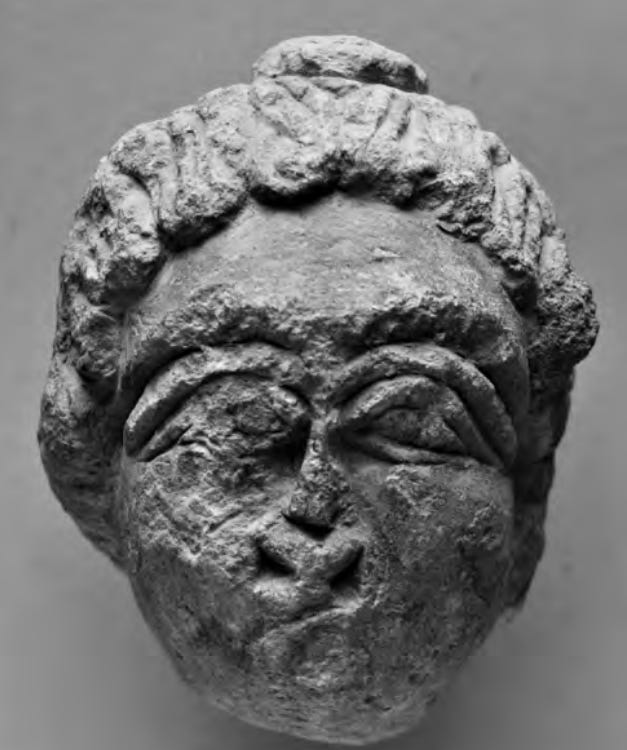
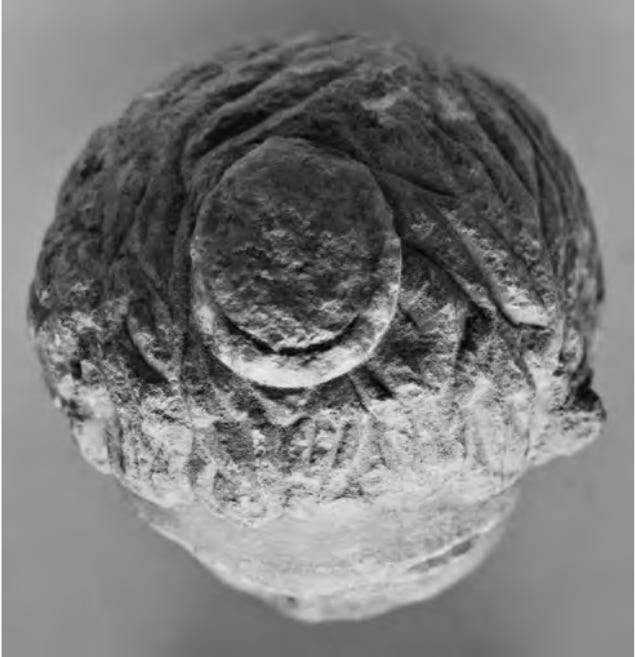
It may not look like much on first glance. Look a little closer, though, and a journey unfolds. The head is made of gypsum (a kind of plaster) and was probably created in the 4th century CE in South Asia. It is the head from a statue of the Buddha, the enlightened figure who is the central teacher, model and, for many, protector and confidant, in Buddhism. Where it was found, though, on at the port site of Berenike, had never been a Buddhist area.
The wide, heavily lidded eyes, distinctive curled hair around the brow and the topknot of hair are all clues that have helped art historians to identify this as a Buddha and to put a date on it. This is done by comparing features of an unknown image or sculpture with examples for which we know things like who/waht is being depicted, and when and where it was made. Similarities in appearance, technique and material can all help to link unknown to known examples. Based on all of these indications, this is a Buddha, but what is it doing on the coast of the Red Sea?
At the time when it probably arrived there (in the 4th-6th centuries, at some point), Berenike was in a Roman Empire that was becoming increasingly Christian. Even if Christianity had not become the dominant religion right out on the southern edges of Roman power, local religions and spiritual practices were not Buddhist. Instead, it had come from somewhere that was largely Buddhist at that time: peninsular South Asia. Today, Hinduism is the majority religion in South Asia, but in the first millennium CE, Buddhism was just as popular, if not more popular, than other South Asian beliefs. Buddhists, and people who supported Buddhist monasteries, were very involved in long-distance trade, travelling across South Asia and beyond it, across the seas, including to Berenike in the Roman Empire.
Stories from the Buddhist tradition, the so-called Jataka Stories, tell of the many lives of the Buddha, when he was born and re-born as various people, animals and supernatural beings, to teach moral lessons. Some are funny, others clever, tragic or perplexing. Lots of them involve ogres, tree spirits and talking birds. And many of them include tales of huge caravans of ox carts crossing deserts with rich merchandise, of daring expeditions by boat and of the wise and canny Buddha, by applying principles of perseverance and gentleness, enriching himself and his followers. Clearly, the Jataka stories are not ‘historical records’ (see: ogres, tree spirits, talking birds, etc.) but they were stories meant to be set in ‘real’ worlds, for audiences that were meant to relate to their messages. And they are stuffed full of merchants and travellers.
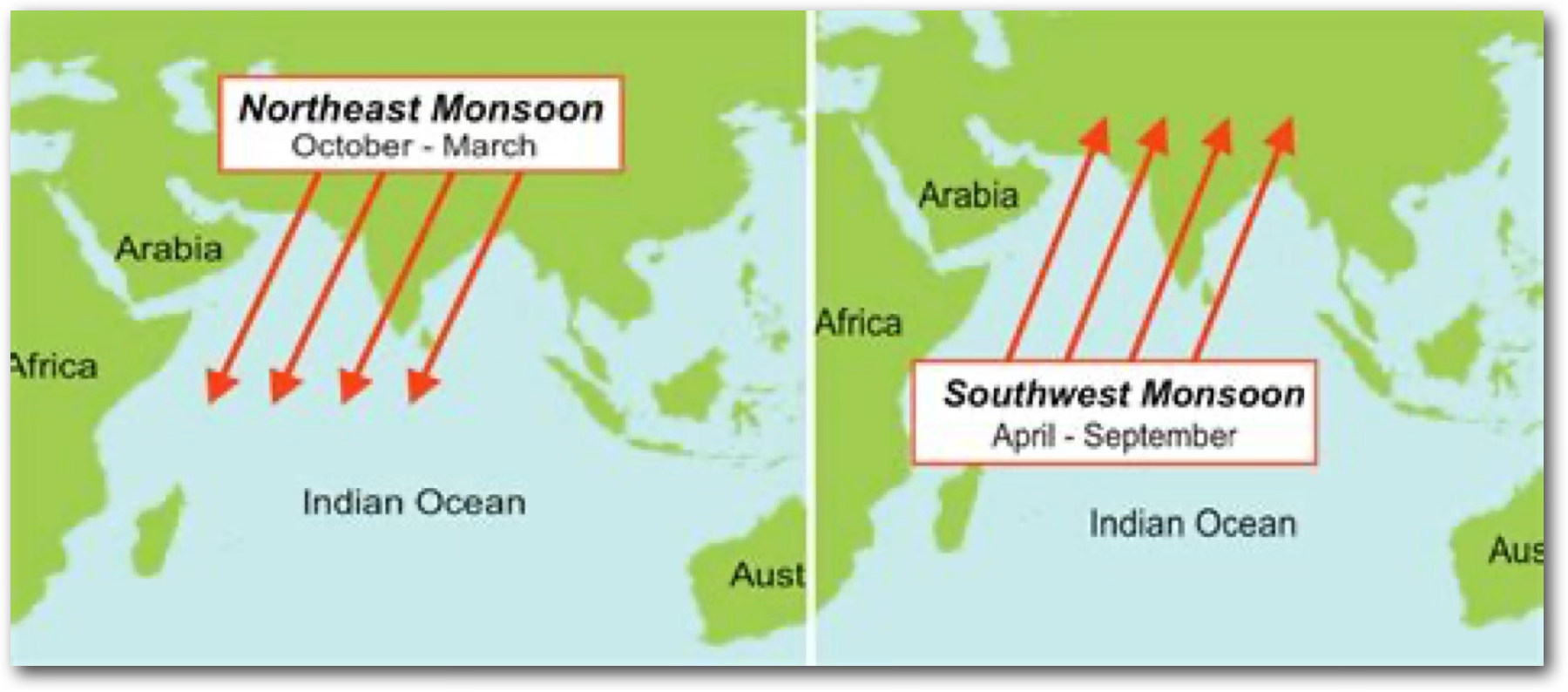
For travellers from South Asia to the Red Sea coast and a port like Berenike, this would have involved weeks or months sat at the other end, waiting for the monsoon winds, which blow one way across the western Indian Ocean for half the year and the other way for the other half, to change direction. Perhaps that is why at least one traveller took their Buddha figure with them, to contemplate and meditate upon in foreign climes, while hoping for the reward of riches of their own. We’ll never know for sure, but the Berenike gypsum Buddha is material proof that such a picture was possible.
Made in… Egypt?
Another even more remarkable find from Berenike deepens the story. It was found three years after the gypsum Buddha, in 2022, but actually dates from around 300-400 years earlier. It is another Buddha:
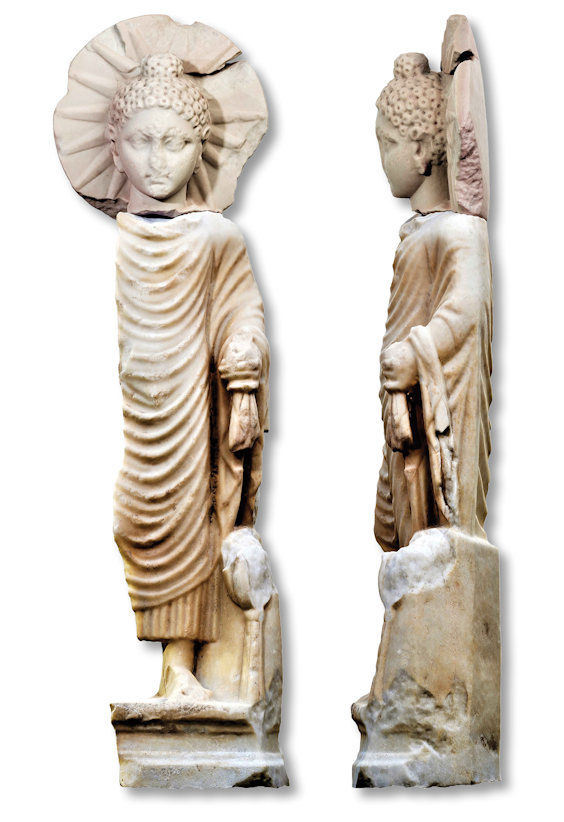
This one was carved, based on its style, in around 100 CE. It has the same features that show it is the Buddha, including the wide eyes, the curled hair style and the topknot of hair. Behind the head is a halo, with a sunburst pattern, denoting holiness of the Buddha. The imagery here is fairly predictable. It was the material that surprised the scholars who examined it: it is carved from rock that can only be found in Anatolia, or modern Türkiye. There are two ways this could happen. First, somebody from the Roman Empire chose some stone from Anatolia, brought it to Berenike and carved a figure of the Buddha, because they had seen it on their travels to South Asia, or seen pictures or statues among South Asians staying in Berenike, or even because they were Buddhist themselves! Second, somebody from South Asia, staying in Berenike, found a piece of stone that had been brought there for some other reason and set about doing some carving. Maybe they were killing time, waiting for the monsoon to turn. More likely, since it is quite a good statue, they were actually a carver and expected somebody in Berenike to want a statue of the Buddha!
These Buddhas of Berenike are unquestionaby interesting. They are a vivid reminder that bits of history that usually get put into very different boxes - the Mediterranean and the Indian Ocean; the Roman Empire and India; Buddhism and Christianity - actually met and interacted. The main reason this is a shock, though, is the creation of those boxes. To study anything, you have to define what it is. For historians and archaeologists, this means saying when, where and what you are investigating. But needing to draw lines can make it all too easy for those lines to seem ‘real’. Instead of being rough, fuzzy gestures towards ‘that sort of thing’ more than ‘this sort of thing’ or ‘sort of over there’ more than ‘sort of over here’, they can come to seem like things that were, and even should be spearate. And the world then, like the world now, just wasn’t like that.
People are unpredictable, and mobile and, very often, interested in the world. We soak up new images, sounds, smells, tastes and ideas and then reflect them back into our own lives. But we also stick stubbornly to the things that feel like ‘us’, that give us a sense of being distinctive in the world, on the one hand, and part of communities in the world, on the other. The Buddhas of Berenike sit in the mysterious space where these impulses meet: we shouldn’t be surprised to find that things often moved between societies in trade contact over centuries, but when those things were not the main goods of sale, it becomes impossible to guess at the particular, perhaps even accidental or even downright weird ways that a gympsum Buddha from South Asia or a stone Buddha made of Anatolian stone might have wound up on this same small patch of dry, arid coast.
They would have stood out, even if they were familiar, in Berenike: things recognised perhaps, but also recogniseably ‘not usually here’. Maybe they were stripped of their spiritual meaning - souvenirs or decorations from somewhere far away and exotic. Maybe they were the opposite - objects that helped people far from home to keep their spiritual identity, or that supported somebody to explore a new way of looking at the world. Whatever their meaning (and that might have changed over time or from one person to another who encountered them), it was rooted in difference. We should be surprised about connections if it reminds us that our own categories are a bit too neat and that the world is always a bit more complex than it seems. But thinking of the world as just one, big connected mass is just another simplification, equally tempting, equally misleading. The Buddhas of Berenike are fragments of connection in a sea of diversity, linking stories we can tell and those we can only guess at - the essence of global stories at a personal scale.