Cliopolis
The past is a foreign country and we are all tourists

Hello,
Greetings and good wishes from wherever I am to wherever you are! For the next few weeks, where I am is on the move. I write this in my very last week in Istanbul. After 9 months it’s sad to say farewell to friends and familiar places but a comfort to know that Istanbul will call me back. When it does, much may have changed, but I’ll have no trouble recognising it. I’ve written here before about why I love the depth of history in this city. Today, though, I’m in a more reflective and, if you’ll forgive me, sentimental, mood. Leaving Istanbul has made me think harder about why those cities where people have lived continuously for millennia have such charisma.
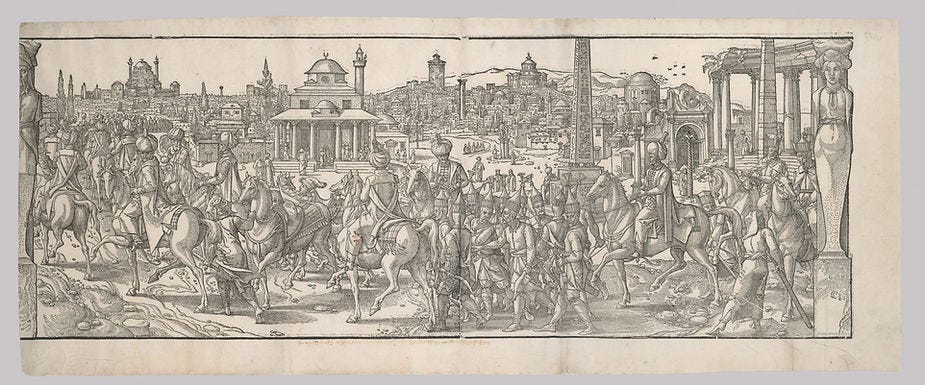
A wonderful presentation I attended this week at the 7th International Sevgi Gönül Conference of Byzantine Studies helped me to pin some of that charisma down. It included an image of a cartoon (meaning plan or design) for a tapestry. The cartoon (now in the Metropolitan Museum of Art, New York) dates from 1553. It depicts an Ottoman procession through the area that had once been the hippodrome, or chariot racing arena, in Istanbul.
The hippodrome was built in the 4th century as part of Constantine I’s refoundation of what had been the city of Byzantium. He renamed the city Constantinople. Chariot racing served as entertainment and an opportunity for emperors to meet the people of the city and show off their power.
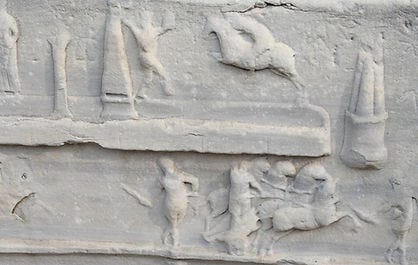
Objects displayed along the spina, or central barrier that the riders circled around, showed off imperial might. They were historical objects (or things made to look like historical objects) that represented Roman control over the whole Mediterranean.
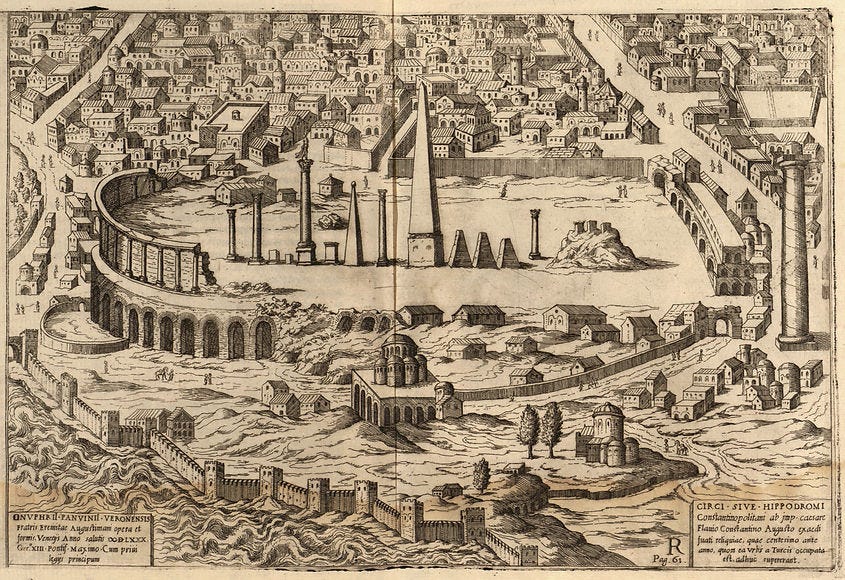
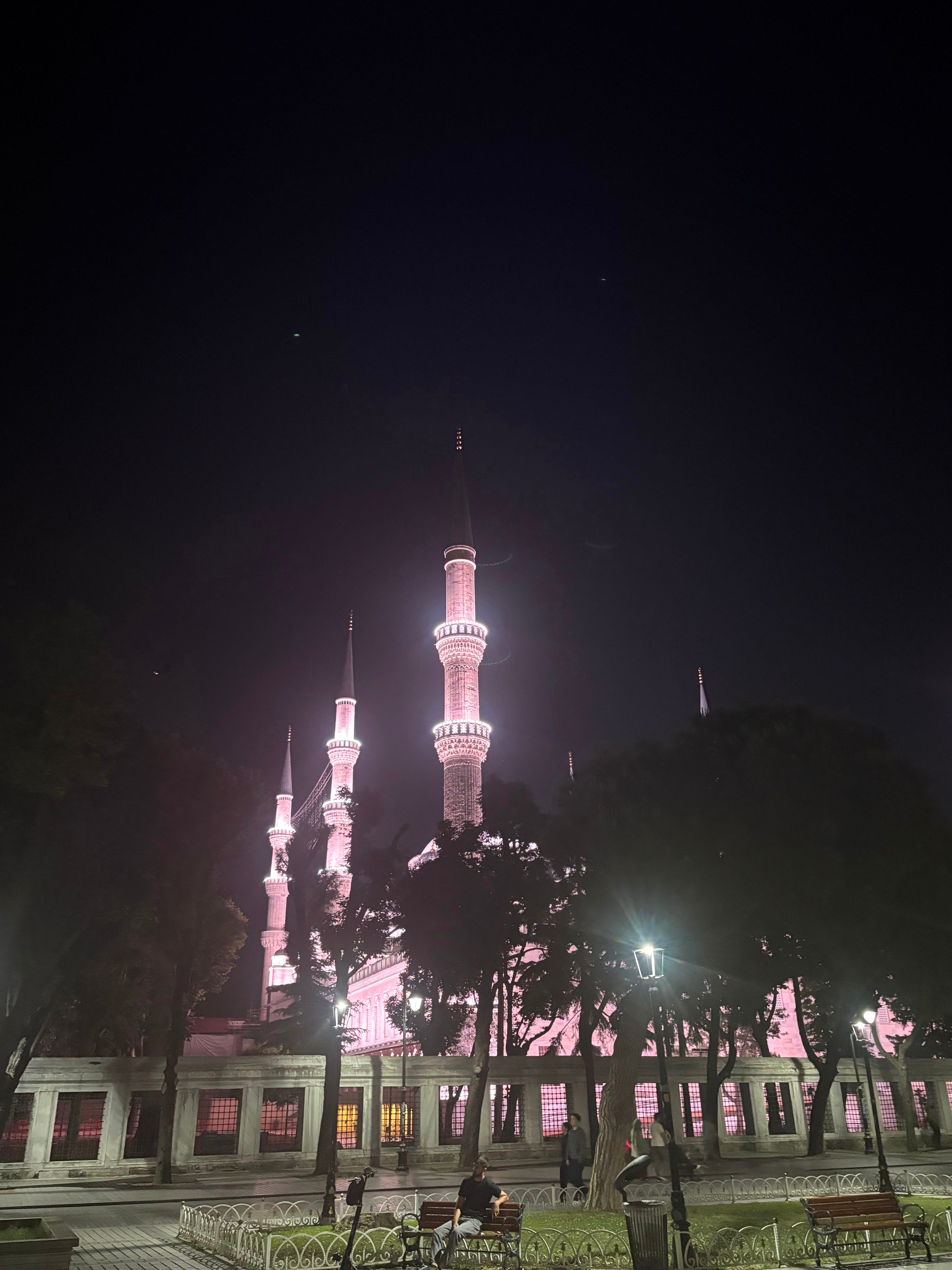
You can read all about the history of these objects and horse racing in the hippodrome here. It is fascinating but isn’t what I want to talk about here. As the slide came up with the cartoon on it, I leant over to my husband and whispered ‘we were there last night’. We had taken a walk with two of the friends made over our time here. It is a circular route I’ve now repeated many times, from Beyoğlu, across the Golden Horn, up to the hippodrome and back. Like the charioteers of Byzantium, we looped around the obelisks, which now stride down the middle of a pedestrian plaza.
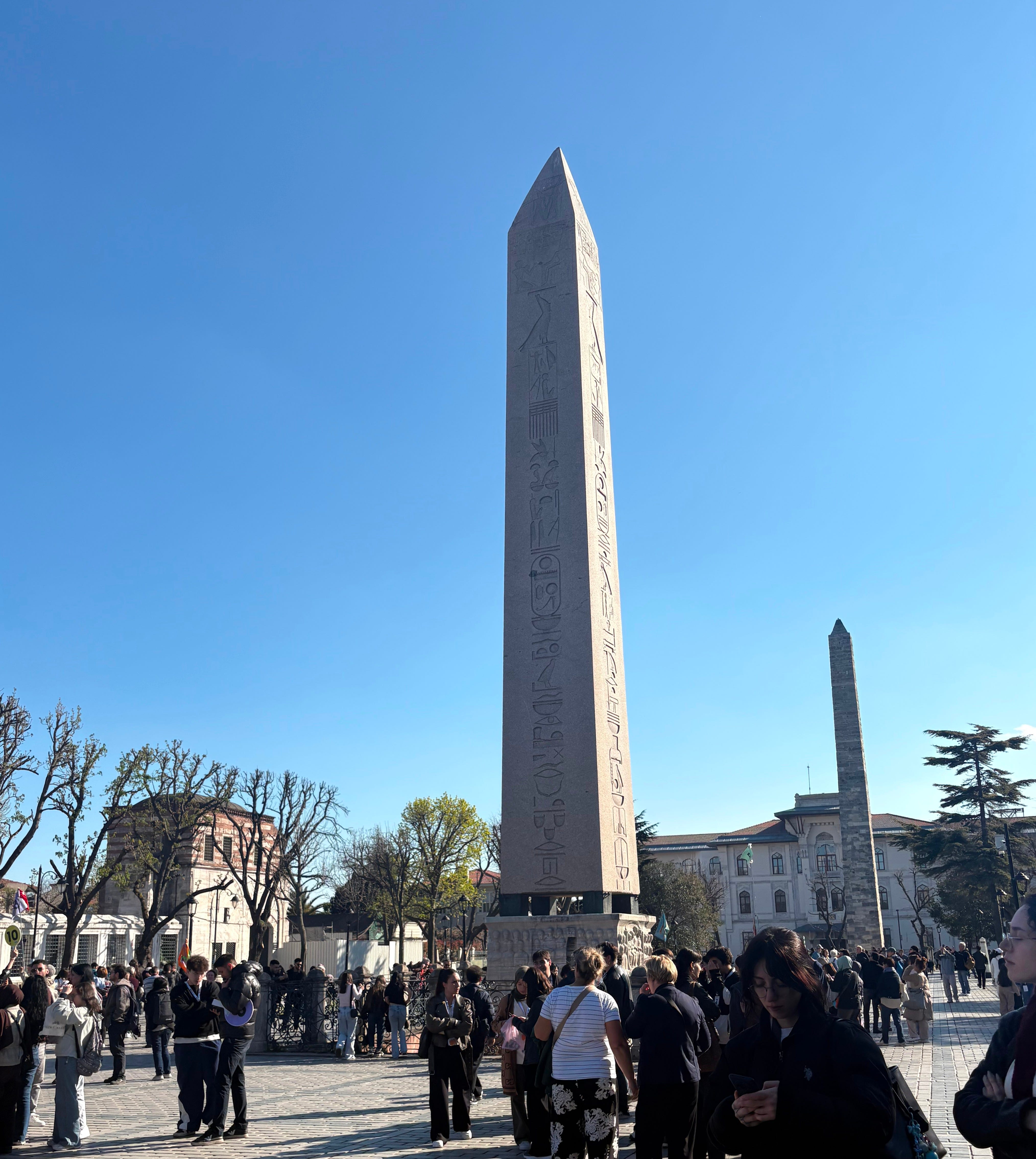
What struck me about the cartoon was that I could place us immediately in that historic scene because the setting has remained so recognisable.
Cliopolis
That is what I mean by the term ‘Cliopolis’. A Cliopolis (combining ‘Clio’, the Muse of History and ‘polis’, meaning ‘city’ in Greek) is, for me, a city that preserves enough prominent features that a resident or a traveller could recognise it and orient themselves in it by the same landmarks as earlier generations. I don’t mean the kind of specialist locating that requires consulting old maps in the archive or standing around squinting and pointing at the corner of a building or the shape of a river bend, to try to get one’s bearings in relation to what would once have been there. That’s fun! It is crucial for understanding the history of towns and cities all over the world. But knowing something was there before makes a city old. It doesn’t make it a ‘Cliopolis’. A Cliopolis is a city where you don’t have to do that work. You see a cartoon from the 16th century and a photo from your walk the day before and there is no question that those two moments in time happened in the same place.
Perhaps the ultimate Cliopolis is Venice. It’s unique location and many centuries of being admired and preserved, mean that maybe more than anywhere else in the world, almost any image from virtually anywhere in the old city would be instantly recognisable as Venice to anyone who had ever seen the city. As I’ve written about, it is probably also one of the reasons I love Venice so much. The reason I’ve decided it’s worth coming up with a term, though, is because it lets me talk about something bigger and more global than ‘some cities I really like because you can see how historic they are’. I do like them because of that, but I think the idea of Cliopoleis (the plural of polis is poleis…) also speaks to something about the value of the past in the present.
Cliopoleis
I always used to wonder why, when people meet one another and discover that they come from or have visited the same places or when people reunite after a long time, we so often ask about places. ‘Do you remember [the classroom where we had German]?’; ‘Did you visit [Marina Beach]?’; ‘We lived near [Bantock Park], what about you?’ Sometimes it can feel like point scoring: I saw more than you or had a better experience. Mostly, though, it is about finding places in common. I’ve seen people, chase this commonness through one option then another. (I have also been such a person.) ‘You don’t remember that place? What about this one? No? How about here?’ The goal is the ‘Yes!’ We both remember being there, seeing that, even if it was years apart or if we didn’t know each other when we both lived a few streets away from one another and are now meeting on the other side of the world, quite by chance.
There are other things you can do this with: did you try a particular food? What about listening to a local kind of music? But these tend to be secondary. They are more ephemeral and perhaps too specific. The place establishes the first overlap of memory. Once we’ve established that we have the place in common, we can share how our experiences of it differed. Our unique memories can exist together. They both make us uniquely who we are and part of a relationship, which is one of the biggest features of being human. We are always working out who we are and how we relate to other people, and every moment we experience changes both.
Cliopoleis are like supercharged electromagnets for this process. Their distinctiveness makes it more likely that somebody else who has also been there will remember. Their features make it easy to build the memory places in detail. They also perform this function through time. They have often been written about or drawn or photographed, frequently over and over and over again down centuries and millennia. Their layout, buildings and sometimes natural landscape features stand as a certainty in those shared memory places. Even if we don’t know the people of the past who lived in and passed through these places, we can know that they saw something that looked like what we saw. And that means that we suddenly have a moment, a point of connection, in common with them. We might imagine a million exclamations of ‘Yes!’ echoing through the centuries: ‘I remember that place! I was there too!’
I guess I love Cliopoleis because, in our constant negotiation of who we are in relation the world - unique individuals, who are nevertheless completely dependent on our relationships with other unique people a lot like us - they make me feel connected. In Istanbul I can walk streets full of stories that span centuries and touch stones that people touched who might recognise nothing at all about my world, but who would still know from my photograph of the obelisk in the hippodrome where we had both been.
Est. 2018
What does it take to become a Cliopolis, though? Every moment adds more depth, more overlap, more connections to a place but how many does it need to count? Some part of me says ‘as many as possible’. One day, I want to go to Olduvai Gorge in Tanzania, where some of the earliest human artefacts have been found, to feel the overlap of millions of years of human stories in a single place. Another part of me knows that there is no arbitrary number. We are making memories and stories, and forgetting them, all the time. A place might be significant now to more people than another because it has mattered for longer, but it had to start mattering some time. Before that, it was nowhere special.
When I leave Istanbul, I’ll be off to somewhere very new. Construction of the Krea University campus began in 2018. A lot of it is still under construction. What will become of it in a hundred years, or a thousand?
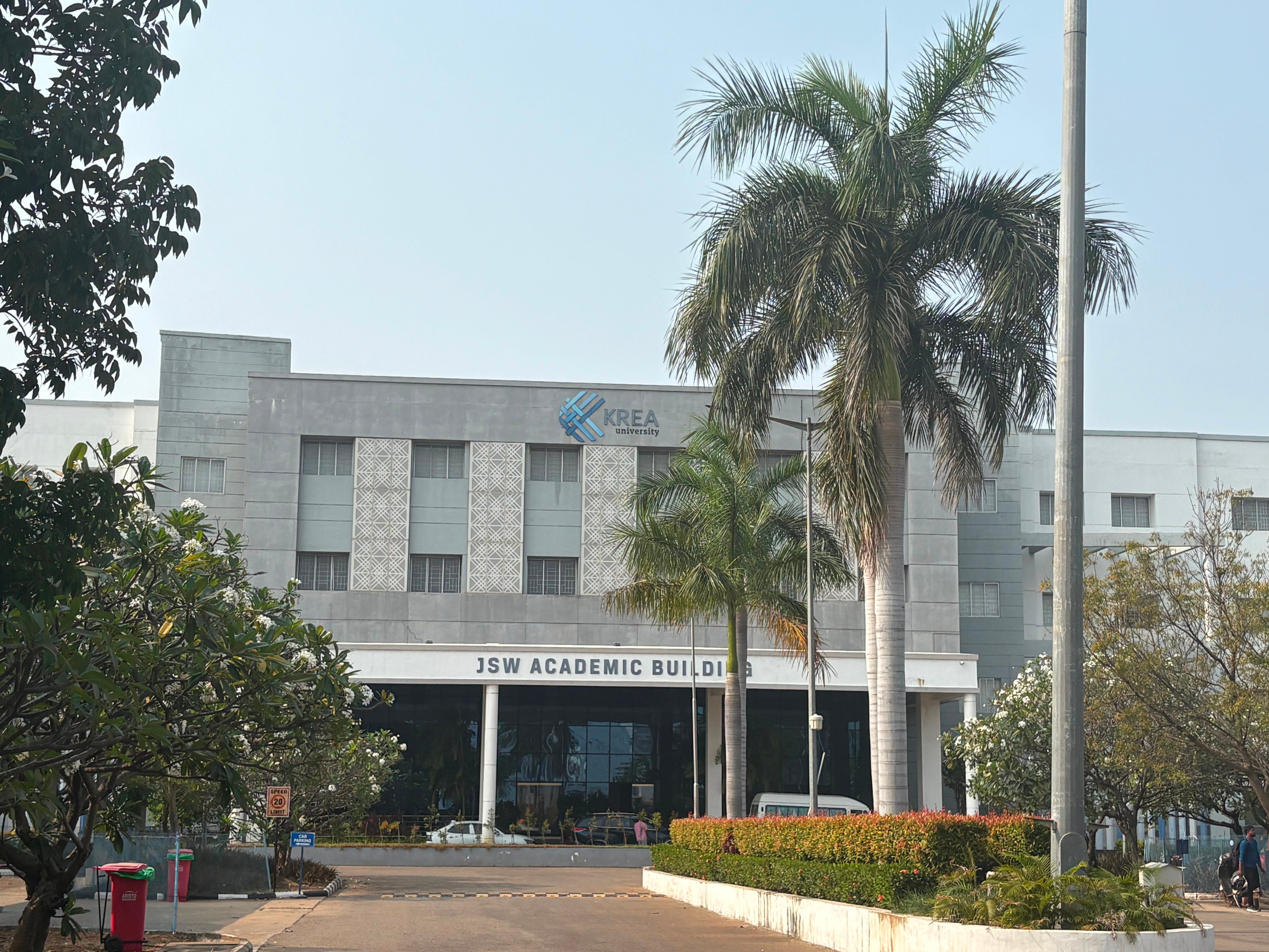
As a historian of the deep past, I have a pretty realistic sense, I think, of how little survives the passage of time. I study entire civilisations that most people have never heard of. I try to reconstruct from tiny fragments of metal and stone political systems that once shaped continents and millions of lives. I know that statistically, Krea, like most places, will not be a Cliopolis. Most places aren’t.
Perhaps that is another part of the charisma of Cliopoleis. They feel like less of a risk, or perhaps some sort of insurance against that statistical probability of disappearance. If you invest your memories, your own story, in a Cliopolis, you increase your odds of being part of those ‘Yes!’ moments. Even if your name disappears and if nobody knows it was exactly you, other people in the far future will know when they walk in the hippodrome or look up at the colosseum in Rome that other people have looked at those same monuments and walked those same routes. In Istanbul I will be part of that same feeling for somebody else that the obelisks give me now: that this is somewhere thick with stories.
Places with only a thin layer of memory don’t come with the same reassurance. They don’t hold the same likelihood of somebody else you meet remembering that same place. But they can be a home for different kinds of stories and memories: of beginnings, of starting something with the hope of what it might become, of investing without being sure. Krea is going to be a big change but I’m looking forward to building those memories with a new community and hopefully one day sitting with old friends from Istanbul chatting about how we used to walk to the hippodrome and whether we both remember the road past the Galata Tower down to the Golden Horn.