

Outside what?
On influence, independence and lace and white Crocs

Hello!
It is a very wet Wednesday in Istanbul as I write this, so I hope it is brighter and sunnier wherever you are reading.
I’m in the middle of a frantic few weeks as my time in Istanbul comes to an end and the arrangements for moving to India start to come together, but there’s still plenty of perspective from the past to be had. I’m looking forward to writing in future about the history of passports and visas, which has become rather interesting to me, for obvious reasons. It will take quite a bit of research, though, for which I don’t really have time right now. This week, instead, I’ve found myself tracking something else through time and via some slightly unexpected routes.
Megaliths and microliths
Around 4300 BCE, in the Neolithic (or late Stone Age), around the Mediterranean, people started doing things that all seem to be connected with a population increase and growing interest in buildings and monuments. This included the construction of highly visible tombs, often called megaliths (literally: big rocks). These were often constructed out of big rocks (hence the name), used to create burial chambers that would stand out against the landscape and provide an easily locatable and recognisable tomb, often for several people over generations. People were often also buried with grave goods, including bone implements, stone tools (a lot of these come under a general heading of ‘microliths’, meaning ‘small rocks’, since they were made of small flakes or pieces of sharpened stone) and jewellery made of bone, stone and shell.
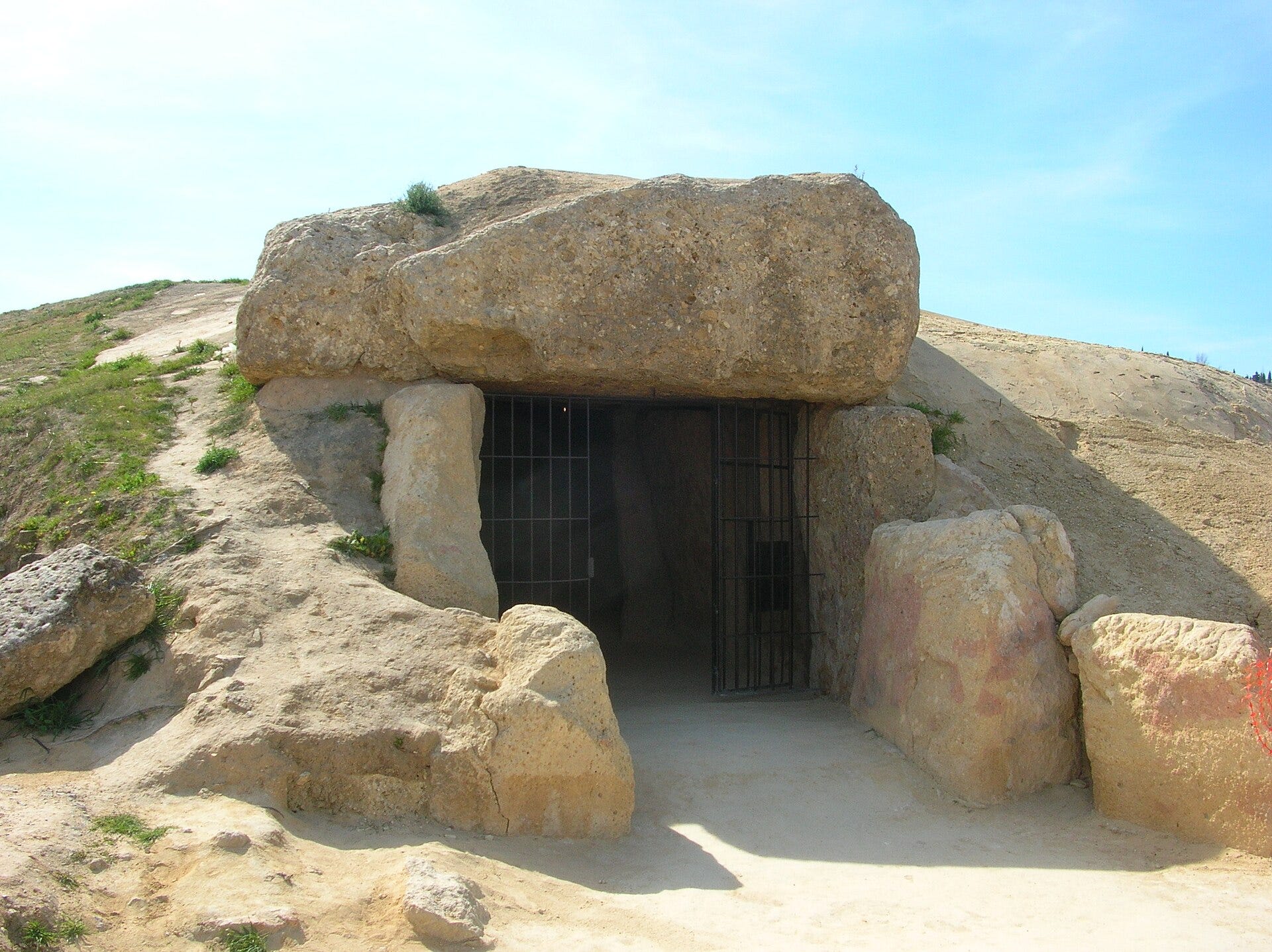
With big changes in how humans live across wide areas comes a pretty understadnable question: where did those changes start? Did somebody have a bright idea and then did others copy it or did lots of people have similar ideas at around the same time, perhaps because of similar changes in their environment? Megalithic tombs have been subject to such a debate. The conventional wisdom for a long time was that they began in one specific part of what is now southern France, then spread around the shores of the Mediterranean (because sea travel was faster and easier than overland travel) and, more slowly, to places further inland. But a recent study of a large cemetery from right in the middle of what is now Spain has called this into question. It dates from very early in the period of megalithic burials, so, being far inland, should not yet have had any or should perhaps have had a few early experiments. The coast was meant to have gotten there first. That isn’t what the dates show, though: this cemetery has several megalithic burials, using some quite distinctive designs of megalithic tomb, with a wide variety of grave goods.
The excavators soberly conclude that,
Instead of having a single point of origin, the emergence of megalithism in Europe appears to follow a multiple model of interconnected regions involving not only the coast but also continental areas.
That all seems fair and reasonable in light of the evidence. What struck me though, was a shorter write-up of the article, that was where I first came across it. It is clear, interesting and accurate: I am not criticising journalists reporting on archaeological finds. Quite the reverse. Academic papers are their own genre. They serve a purpose and that isn’t to communicate to an interested reader over their morning coffee what the current state of knowledge is about e.g. Neolithic burials in Europe. Journalistic coverage is critical. It also often brings to the surface things that are hidden in the academic prose. In this case, it is a contrast between people being ‘connected’ or ‘influencing’ one another, versus being ‘isolated’ or ‘independent’. For example, the write-up states,
The Valdelasilla site poses a serious challenge to the dominant theory that monumental burial traditions originated in a single coastal region and radiated outward along sea routes. If a community on the landlocked Spanish plateau was independently designing megalithic tombs at the same time as groups on the Atlantic and Mediterranean coasts, the France-first diffusion model breaks down.
It goes on to say,
Megaliths stretch from Scandinavia to North Africa, and the question of whether that tradition spread by migration, trade networks, or independent invention is one of the oldest debates in European archaeology. Valdelasilla offers hard evidence that at least some inland communities created megaliths on their own.
In essence, this is the debate over megalithic tombs: one idea diffusing from one community to the next, or a cluster of similar ideas popping up together and then spreading out, possibly in a more irregular way? It isn’t a silly question but it does tend to set up some rather unlikely alternatives. One is a world of people who simply picked up on whatever their neighbours were doing, copied it and then got copied by their own neighbours, raising the question of why everybody didn’t eventually end up exactly the same. The other is pristine communities independently crafting their own unique cultures, unless, by chance, they happened to stumble across one another and ‘borrow’ things that remained distinctive of one or the other, raising the question of how the same things ever came to exist and be considered normal across distinct and diverse cultures. From these two ideas come some other equally troublesome ones, such as that some people influenced, while others were influenced, or that cultures were either ‘pure’ or ‘independent’ or were simply copying what was around them. Reality, of course, is always more complicated.
At the inland site with the early megaliths, for example, the only objects found in some of the graves that were not locally made were… seashells. So there was at least some contact with the coast. Perhaps somebody did see an early megalith on the coast and thought, ‘hey, we could do something like that!’ Diffusion among humans isn’t like the chemical process: if you drop a teabag into a cup of hot water, the tea will spread outwards, not quite uniformly, but pretty predictably, from a stronger tea colour right around the teabag, right out to clear water at the edges of the cup, at least at first, while the tea spreads, until it is the same strength everywhere in the cup. If an idea gets out into the human world, though, it might not make much of an impression where it first happened at all. It might skip over the areas right around it because a traveller picks it up and carries it far away. Somewhere else it might become all the rage or be changed into something quite hard to recognise.

There are, historically, very few fully ‘independent’ or ‘isolated’ human societies. Ones that are tend to be small. They are outliers. Unless they managed to find a way out of that situation, they died off for want of genetic diversity. For most people, even in the very distant past and in pretty inaccessible places, connections with other people have been a constant part of life: travellers, traders, pilgrims, diplomats, migrants. Sure, at times, continental regions have developed without much connection to one another, but within those regions (which are vast!), thousands of different culture groups moved and travelled and shared ideas and material. In 4300 BCE, people in Spain did not have any idea what people in Australia or North America or southern Africa were doing, or vice versa. But that doesn’t mean people in those regions were isolated or lived in homogeneous groups. Instead, hundreds or thousands of societies with their own distinct identities, made up of languages, clothing, behaviours and ideas, met and knew about one another. (And it is increasingly recognised that humans moved across even the huge distances between continents at least sometimes!)
The Seljuks of Rum
Another quite tricky notion that lurks inside the idea of influence versus isolation is that ‘authentic’ or ‘original’ cultures develop in isolation, that somehow copying, imitating or borrowing from others involves grafting things that are ‘alien’ onto something that is ‘indigenous’. That really isn’t how cultures develop though. If societies in isolation are vanishingly rare, then cultural variation is not. Societies acquire and tend their differences in dialogue with one another: by what one group of people use from their environment that another ignores, or the way that another group learns to inhabit one ecosystem while another specialises in living in a neighbouring ecosystem. Often societies explicitly define themselves as being the way they are because they are different from the people around them in particular ways.
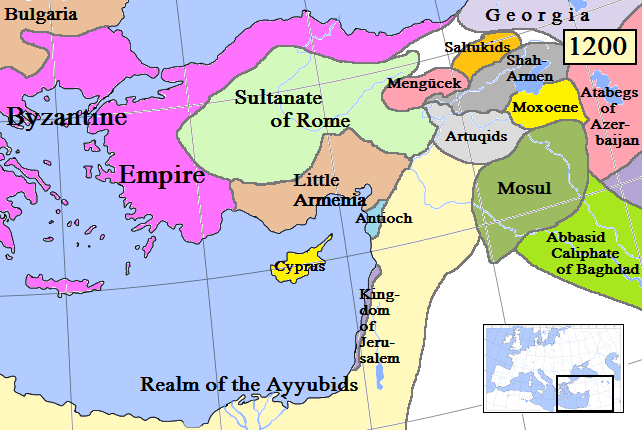
This was brought home to me this week by a lecture about the Seljuks of Rum, a group of medieval rulers in Anatolia whose world I have been learning more and more about this year in Türkiye. Between the 12th and the 13th centuries CE, the Seljuks were an important power group in eastern Anatolia. Sandwiched between the Greek-speaking, Christian Byzantine Empire to their west and the mainly Persian- and Arabic-speaking Muslim Ayyubids of Egypt and West Asia, they were Muslims and speakers of a Turkic language.
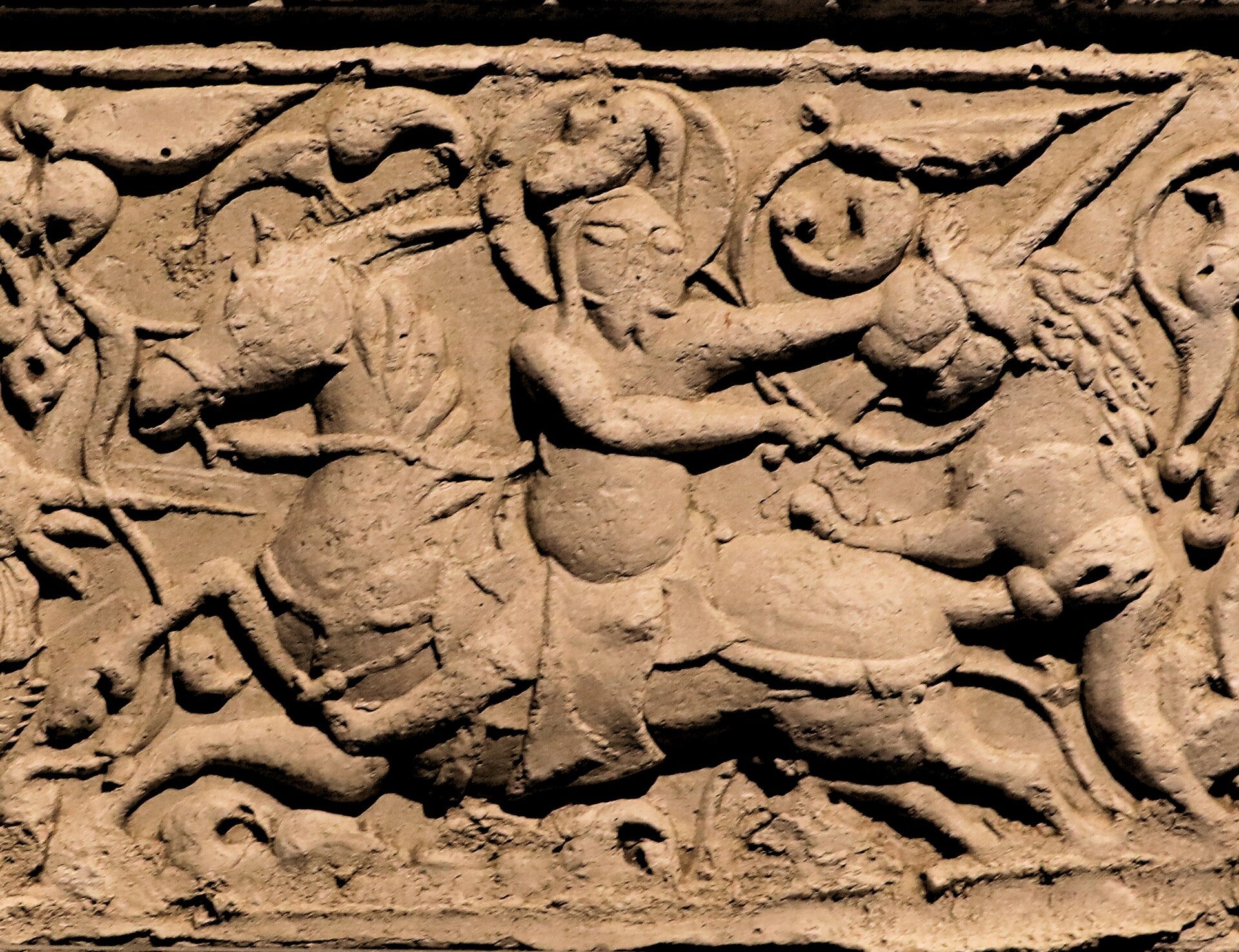
Seljuk art, architecture and literature is highly distinctive. As the lecture I attended emphasised, the Seljuks used these diverse elements to build an identity that included multi-lingual poetry, images with elements drawn from Iran and Central Asia, and Christian and Muslim practices. They drank wine, rode horses and commissioned the building of mosques and churches. Their imagery drew on what was in the world around them and on legends and historical pasts. They called themselves the Seljuks of Rum because their land covered what had for centuries been part of the empire of Rome. Their sultans were called things like Kaykawus, which echoed names used by the Sasanian Persians, an Iranian empire that had fallen over five centuries earlier.
Perhaps the most famous poet of the Seljuks, and indeed, one of the most admired poets in history, was Jalāl al-Dīn Muḥammad Rūmī, usually known as Rumi (1207-1273 CE). He wrote in Persian and Arabic, sometimes using sentences and words in Greek and Turkish, on faith, learning and love:
Out beyond ideas of wrongdoing and rightdoing,
there is a field. I’ll meet you there.When the soul lies down in that grass,
the world is too full to talk about.
Ideas, language, even the phrase each other
doesn’t make any sense.1
Seljuk culture was an expression of the lives of people, from the richest and most powerful to the poor and populous, who were making collective sense of their place in the world. They lived in lands that had been ‘Rum’ for centuries: that was part of who they were. They came from Central Asia and spoke a language that connected them to people across that wide open steppe. They believed in Islam but their neighbours to the west and probably many people living in their lands, who were already there when they arrived, were Christians. They adopted languages of power and prestige from Iran and from the Roman Empire and combined them in unique ways. Like all of us, they looked to the world they lived in, the stories they grew up with and the people around them to decide what made them them and what made them different from others.
Crocs and lace
This week was productive for thinking about culture and ideas of isolation and influence! If you read UK media at all then you probably know that it was the week when Venezuela Fury, daughter of heavyweight boxing champion, Tyson Fury and his wife, Paris Fury, married her fiance, Noah Price. If you don’t engage much with the UK press, or didn’t read the stories any further than that headline, the key details, as far as they matter for what I’m writing about are:
Tyson Fury has made his name as a boxing heavyweight (in every sense) and goes by the self-proclaimed title, ‘the Gypsy King’;
He and his wife, Paris, are both members of the UK Traveller community and are well-known public figures and representatives of the wider Gypsy, Roma and Traveller cultures;
They got engaged and married young, in accordance with Traveller tradition, as have Venezuela (16) and Noah (18);
Noah is also a Traveller and an amateur boxer, hoping to follow in his father-in-law’s heavyweight footsteps;
Venezuela said publicly that she didn’t want a ‘big fat Gypsy wedding’ (a concept popularised by a television show of the same name) but that didn’t mean it was a lowkey affair!
The newlyweds, after their honeymoon, will move together into a caravan close to Noah’s parents’ home, which is also what Paris and Tyson did after their marriage.
Why does any of this matter to a discussion on Neolithic cemeteries and Seljuk art, you might reasonably ask? Gypsy, Roma and Traveller cultures in the UK are part of a wider group of cultures across Eurasia, with centuries of history as nomads. The various groups have their own customs but also similarities, including a focus on extended family networks, distinctive languages that are often not meant to be taught to people who are not members of the community, food cultures rooted in the practicalities of travel, a close connection with horses, and an emphasis on faith and traditional family structures. Gypsy, Roma and Traveller communities are important in a discussion about isolation versus influence because they undoubtedly have distinctive, recognisable cultures, on the one hand. On the other hand, they have never been ‘separate’. Nobody has! But this is so much more obvious with groups who have never had or claimed to have a land where, once upon some mythic time, it was just them and their culture with no ‘outside’ influences.
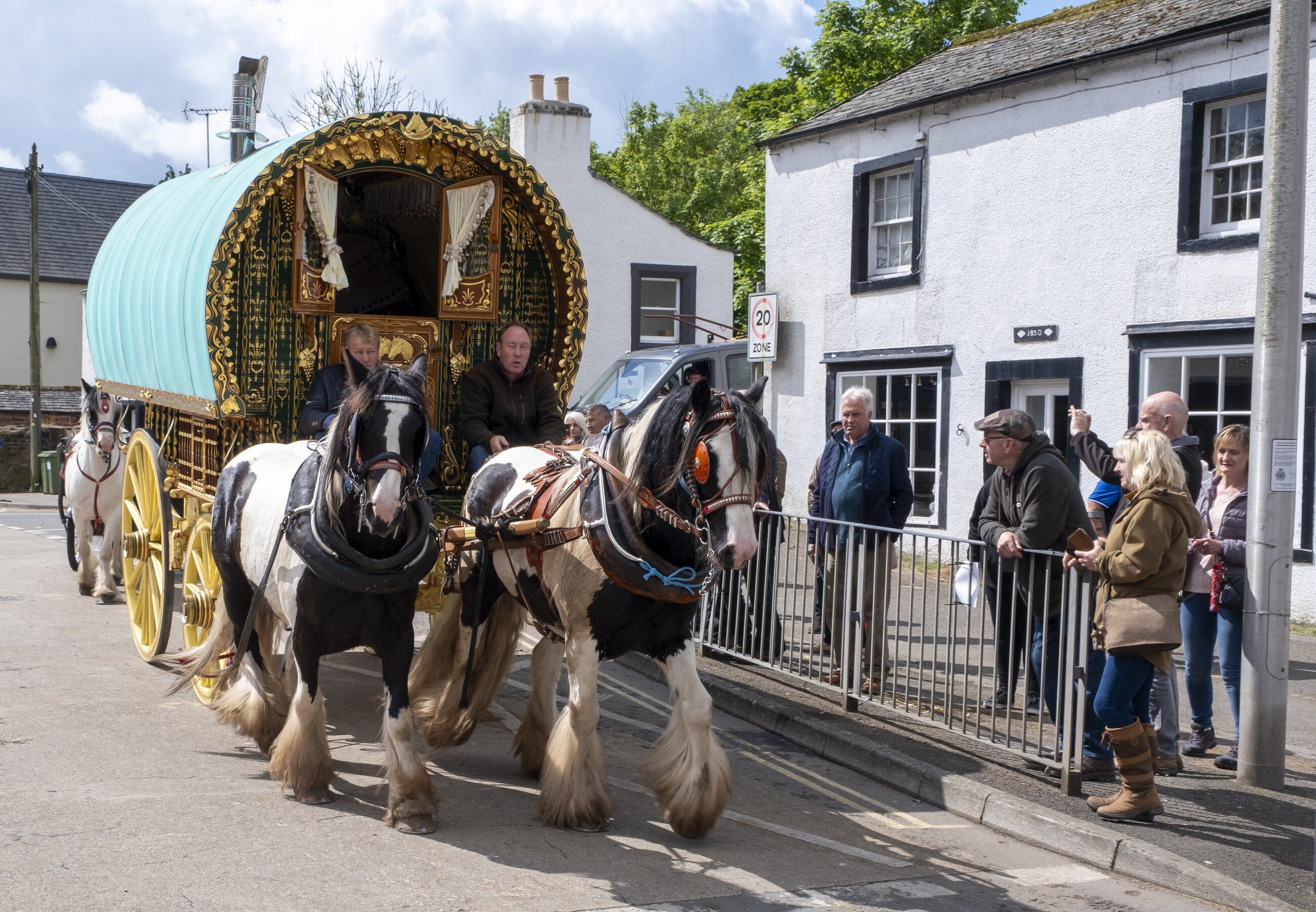
Gypsy, Roma and Traveller communities have developed their culture in constant dialogue with other societies in which they live and through which they travel. They have made sense of their world through stories and practices that focus on explaining how they are distinctive from the non-nomadic societies around them but also from each other. Their cultures have also developed in the same places as others, and in response to similar requirements of nomadic life between different Gypsy, Roma and Traveller groups. Food, religion, language, family structures: they are all combinations of similarity and difference, crafted into whole, identificable but never sealed off or static cultures.
And that brings me back to Venezuela and Noah Price: their wedding, as it has been presented publicly (I wasn’t there!), was a celebration of Traveller culture and values. It was family-centred, religious and lavish, including a cake considerably taller than the father of the bride (who stands at 6’ 7” or just over 2 metres).

The bride and groom are both teenagers from within the community, following traditional marital practices shared with parents and earlier generations. The bridal gown (despite eschewing the television-show stereotype) involved a lace train several times the legnth of the bride and designed and executed by a boutique from the north of England, where Traveller communities, including the Furys, have a strong presence (rather than London, which is where celebrity wedding attire would usually, by default, be sourced in the UK). The newlyweds will continue the tradition of living near the groom’s family and in a caravan. Yet Venezuela Price is not a figure of frozen tradition. She runs her own influencer business. She grew up in mansions and travelling in private jets. And under her 50 foot (25 metre) lace-train wedding dress she walked down the aisle in a pair of white Crocs.

This is culture in action. It doesn’t develop in ‘isolation’ then meet with other ‘isolated’ cultures. There isn’t some weird swap-meet or a watering down of something ‘real’ into something ‘less real’. It isn’t fixed over time and it doesn’t replace people’s ability to make choices and decisions, even if it does have a huge impact on those choices and decisions. Culture is created constantly, by each person and generation, by back-and-forth over who is included and who isn’t and how to tell and who gets to decide. Groups define themselves by how they are different from other groups in some ways but they may be similar in others that don’t seem to matter for telling people apart. Ideas can travel within cultures in ways that are nothing like tea diffusing in a mug.
We may never know exactly how or why a community in inland Spain more than 5000 years ago began building megalithic tombs. Did ideas travel with seashells from communities on the Mediterranean coast? Or did they create tombs for their dead that then inspired communities on the coast? Was it a bit of both - an idea travelling between groups, then elaborated in a hundred local situations? It is impossible to know exactly why one particular Seljuk poet or carver or pottery painter chose this image or that language to depict their world, but it is impossible to deny that collectively, the Seljuks recognised themselves and were recognised in their world as a distinctive culture. In the age of the internet we can know a lot more about why Venezuela Price and her husband chose the wedding that they did, but in a world in which Gypsy, Roma and Traveller communities remain fiercely discriminated against, the cultural values and practices that shaped those choices are often not given nearly as much attention as those of people who lived centuries ago!
There is so much more to say about culture than I possibly can here. It isn’t an individual free-for-all. Nor is it a blueprint for how every member of the culture must behave. Cultures can be oppressive, creative, rigid, resilient or fluid and flexible. But what they never are is sealed off from one another, perfect shapes that create themselves then encounter one another. In that respect they are just like us: we don’t create ourselves in isolation then, only when we are ‘whole’ or ‘complete’, go out into the world and meet other people. We all shape each other all the time, or as Rumi said so much better:
People are going back and forth across the doorsill
where the two worlds touch.
The door is round and open.2
This is an extract from Rumi’s beautiful poem on love, ‘A Great Wagon’. The full text is available here.
From the same poem.