

The rain has come
Monsoon from the inside

Hello,
Happy Friday and all best wishes to you where you are. I’m settling into Sri City and at last, as the trees were visibly wilting and the campus pond had dried to cracked mud, the rain has come. I don’t think we’re into the full fury of the monsoon yet. People have warned me to expect serious rain in October and November. (I don’t think they realise how much I’m looking froward to it!) Still, most days at the moment we get at least half an hour of rain, often a bit more. The pond is starting to fill up again. The trees look fresher. Thunder rolls in from the sea.
Rain was the focus of a campus event this week, too. The Krea Literature Society organised a poetry reading by one of our Faculty. Prof. Bishnu Mohapatra has published poetry collections in English and Odia, the majority language of the state of Odisha in northeastern peninsular India, and widely spoken in a large surrounding area. At the event, he read poems from his new collection, Rain Incarnations, in Odia and English. Some he had originally written in English, others have been translated for the collection by Apparna Uppaluri. His renditions in both languages were equally moving. I strongly recommend the book: it is beautiful, fun and reflects a scholar who has travelled widely and paid always paid keen attention.
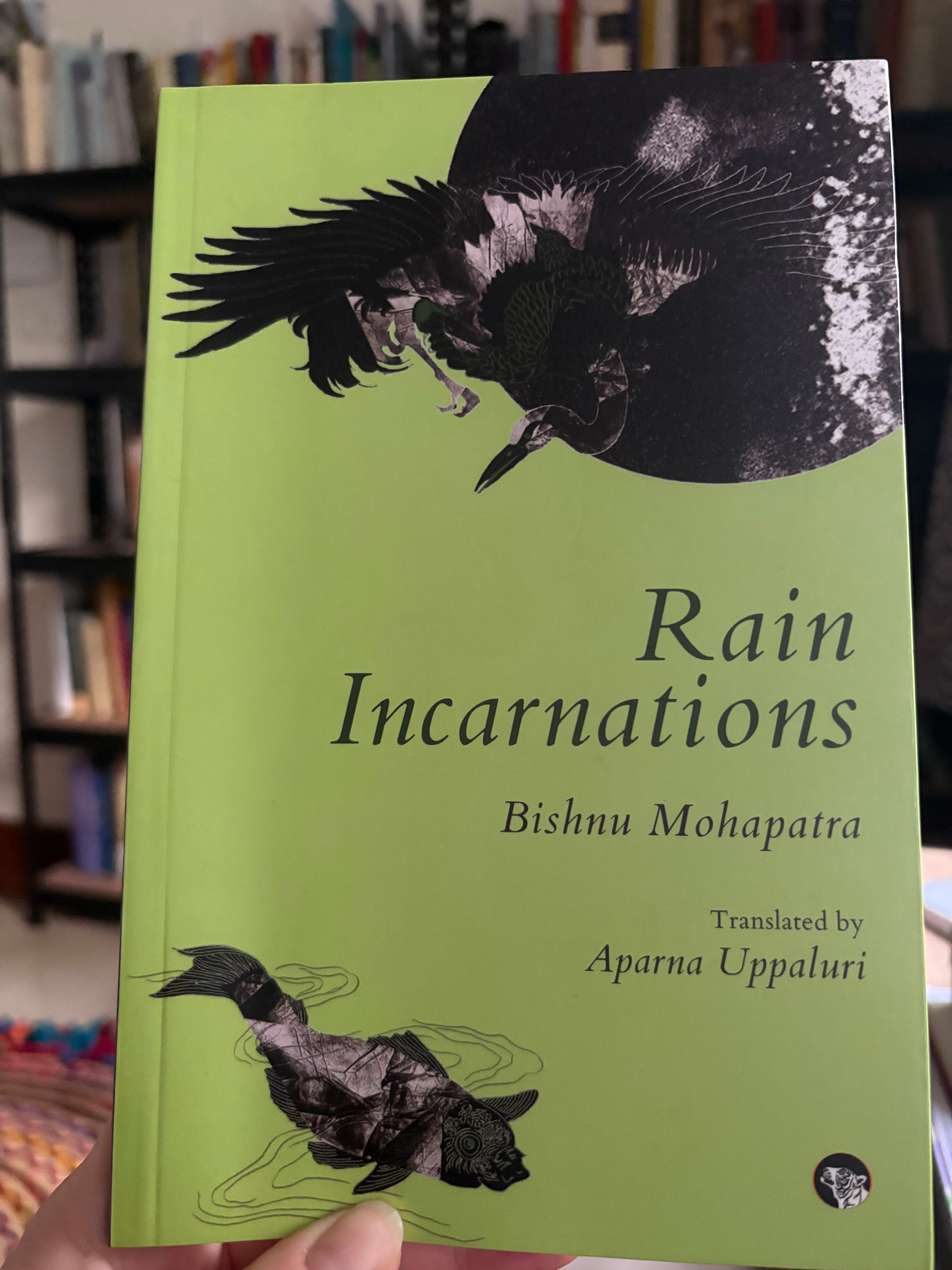
One particular poem struck me as particularly appropriate this week:1
A Long Wait
Rain reached after a long wait, after many thirsty nights.
Rain finally arrived -
soothing the pain of the parched land.
Has the wanderer poet left behind this rain?
Did the tired clouds follow the poet, tripping
over mountain peaks?
The poet’s sharp words, a procession dazzling the sky,
his half-woven dreams, meandering earthworms in the soil.
Everything changes in front of our eyes.
Blood flows once again through the arteries of rocks,
raindrops glisten on the thorns of a cactus.
All through the night birds peck at scattered stars,
leaving a bare morning sky.
The wanderer poet has travelled far,
his feet covered in the dust of a faraway land.
An unknown hope hops in his heart.
Grasshopper.
A deep structural element
I don’t want to reduce Bishnu’s poems to reflections on rain in South Asia. Their themes are much bigger and so is the world he writes about, but they are also deeply rooted in place and the material of the world. Whether it was in his mind or not, when he wrote ‘Blood flows once again through the arteries of rocks’, my mind immediately conjured the distinctive red pre-Cambrian rock that sweeps diagonally up the eastern side of the South Asian peninsula - the red dust that covers my feet around campus and has done so on almost all my travels in India. Right now I know from friends and family in the UK that rain has not yet reached, after an unusually long wait. The land is parched. Even so, the focus in the poem on the arrival of the rain seems to me to speak more of the monsoon cycle, with its dry and its rainy seasons, than of Britain, which is normally so much more moist. For me ‘A Long Wait’ will always be the poem of my first monsoon in India.
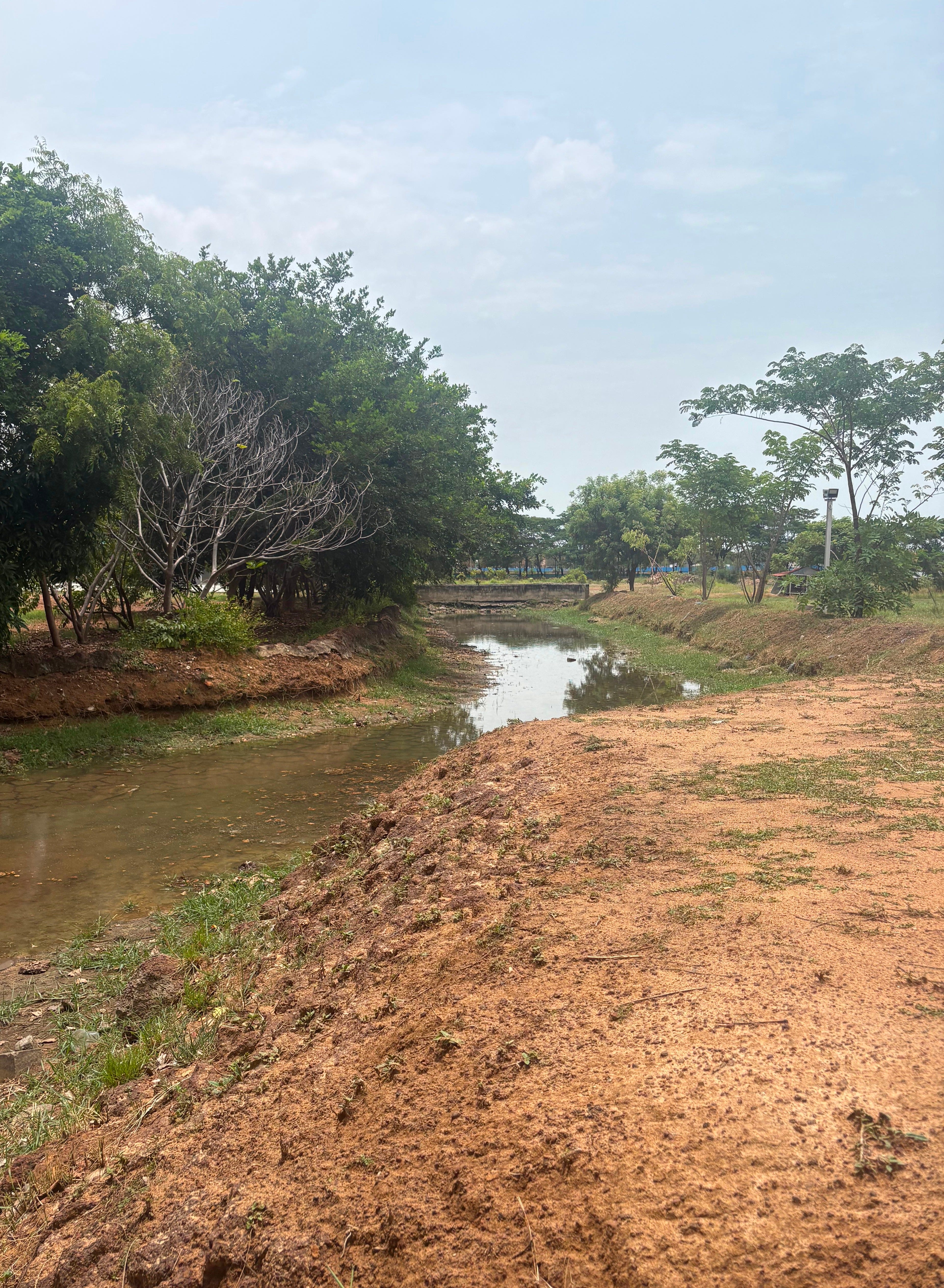
My first monsoon is an experience I’m looking forward to in part because I’ve spent so many years talking about the monsoon cycle, trying to get it clear in my head so I didn’t make a terrible mistake while giving a talk about how it shaped ancient trade, or imagining how the annual rains carried people across the ocean then held them in place/out of place for a few months every year. The monsoon has been described as a ‘deep structural element’ in the history of South Asia (and everywhere else around the shores of the western Indian Ocean),2 meaning that, in terms of human time, it has functionally always been the way it is, creating opportunities and barriers to movement and, above all, shaping the cycles that people have lived by in places like South India.
That got me thinking about poetry from the periods I study and how those wandering poets thought about the rain. I’ve written here before about the very particular cultural role of poets around the turn of the first millennium CE in this region of South Asia. They wrote in Tamil, in a land of warrior kings, who gathered war bands around them with the promise of exotic luxury goods (including wine and gold from the Mediterranean), feasting and booty, and the glimmering possibility of immortality. That was what the poets offered, travelling from one royal court to the next, even given safe passage by kings at war with one another. Several thousand poems have survived in anthologies collected already within a few centuries or maybe even less of being written. The poems can be grouped into two themes: romantic love and martial glory, or, as they have sometimes been called, songs of love and songs of war. They offer glimpses into a deep past and one that the poets often tell us about very directly. They are characters in their own stories, pleaders in their own cause. If they offered kings immortality, kings rewarded them for their wit and eloquence with a bed for the night, food in their stomachs and, perhaps, some of those exotic luxuries. This poet uses the rain to make his case, though we don’t know if it worked:3
If the clouds thought, “We’ve rained other days!” and stopped raining,
if the fields thought, “We’ve grown food before!” and stopped growing,
there would be no life at all then for any being that draws a breath!
If people like me make requests, if we say, “Give me something again!”
it is cruel for a person like you to refuse them with the answer that
“you have gotten gifts from us before!” King whose chariot is handsome!
Those who are approached with the confidence that they will give - and who
do not - disappoint far more than those who do not have anything to give.
You are not that kind of man! You are generous! You do your duty
to bards! With the words “These are yours!” you grant them fortresses
difficult to conquer, even when they are still
in the hands of your enemies! My lord, be faithful to your duty of sheltering bards!
This poem made me laugh when I first read it. I didn’t know where the poet was going with the rain and the fields, although I found the willingness to imagine a world stripped of its certainties exciting - the first couple of lines would make an equally good opening to a futurist dystopian novel. Then I saw the punchline and wondered if the king laughed too. Presumably he did or this poem wouldn’t have made it into an anthology!
If that poem, taken from among the songs of war, underscores the way that rain and earth defined the parameters of life itself 2000 years ago, then another, chosen from among the songs of love, captures that quickening of the dried out land when the rains come but also the drama, even the terror of it. Flooding is an ever present risk during the monsoon. And even lying in my flat, under an electric light, the thunder and arcs of pink lightning are awe-inspiring and stir a little bit of the fear that caused people all over the world to give thunder and lightning the names of gods or to give them to the gods as weapons. Here, the poet uses the coming of the rain to contrast joy, beauty and hope with the other great theme of the early Tamil anthologies: the longing of the parted lovers.4
The black clouds massed across the wide sky
unleashed a rain that poured down
like the water when you break a palmyra fruit
and the hail was like the trembling inflicted by a malignant god.
Now, lingering in the sky, the clouds sprinkle bright drops
as it dawns, and on the earth that seems painted with red,
a flow of clear spring water seems to have been dammed up
as a doe with a springing walk, embracing her little fawn,
drinks with her lordly mate whose horns twist to the right
and rests in the shade of a kuruntu tree with swaying branches.
Pitavu trees open their buds as bees taste them, buzzing,
a peacock with lovely spots cries out,
and on the lined sand, like coral mixed with blue sapphires,
the faded flowers of kāyā and red velvet mites are spread beautifully,
ornamenting the wet earth.
It is the time of the rains when the land is lovely,
and my dark woman, surely, thinks that her man
is very cruel and doesn’t love her
as he stays away doing his duty in the camp of a king
whose elephants have curving tusks.
Not knowing how I long for her, she must be very angry.
by Kapilar
This poem is typical of the songs of love, especially, for its rich and detailed picture of the natural world and its seasons. For the poets of the anthologies, different ecological zones (called thinai) could act as a shorthand and a natural backdrop for different moments in the narrative of love, from first meeting and stolen assignations to contented marriage. Here, kuruntu is the wild lime tree. Pitavu are wild jasmine, which for me has always been the smell I associate with mornings in the cities of South India, when garlands of jasmine flowers are sold in bundles for decorating homes and hair. The kāyā are memecylon umbellatum, or ironwood flowers.
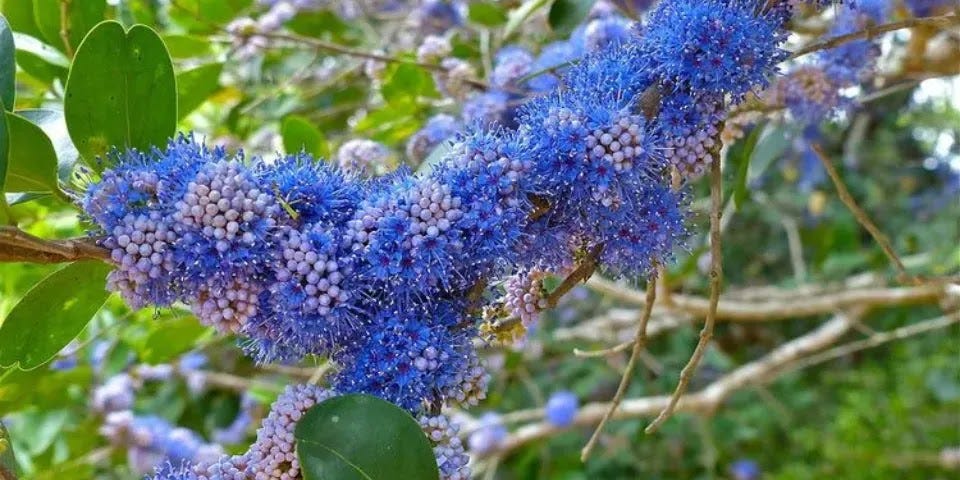
Rain, from the Tamil anthologies to Rain Incarnations, has played its many roles, as a bringer of hope and renewal and a washer away, whether of things we are glad to see gone or whatever we are desperate to preserve. As you will know if you have been reading here for a while, I do believe (not all historians do) that there are things common to the human experience, across time and space: things we share, even if we describe or understand them differently. If nothing else, we are all material bodies moving through a material world trying to make sense of ourselves and it. In the next poem, from the Tamil songs of love, another parted lover, this time the woman, feels the rain as cold and numbness. It paints her world in dreary shades. There are no flowers here, except as a faded memory, but the running water might still melt her lover’s heart.5
In the final days of the rains, as the cold clouds shower down,
and the sky roars and all the different flowers fade,
my heart is filled with numbness and, alone,
I think of him who left, my few bangles growing loose,
and anxiously, I gaze in the direction where he will be coming.
You don’t think I’m pitiful, suffering so I almost die,
O north wind, with your cold on this winter midnight
that seems to make the hills shiver and the lotuses blacken
in the drops that are everywhere like water sprayed
by an elephant. It’s as if you have come only for me.
Now, without tiring, you must go just as you are
to the land where my cruel man is and make his heart melt
like a mound of sand in running water so that he
who had such a will for getting wealth will remember me.
by Kalaarkkiiran Eyitriyaar
I could pull all sorts of historical details out of these poems: human elephant interactions, the use of chariots, the role of kings. I could, and in other works I do. But I especially love the previous poem because it so stubbornly resists being just ‘a source’. It could be from any time, from any place where somebody has felt that their lover is spending too much time trying to get rich and not enough on them. Why not end, then, I thought, on another of Bishnu’s poems, which I will try to historicise a bit? Let the words of 2000 years ago stand on their own while we look for a moment at what a future historian might divine from our wandering bards. It is called ‘Identity’. As I wrestle with the final details of immigration procedures in India and a year of crossing borders, moving jobs, subscribing and unsubscribing from services private and public, this poem caught me because it seemed on one hand incredibly bounded and specific, to this brief, bureaucratic time we call sometimes call modernity, in which everything has a form and an official label.6 On the other hand, of course, who we are and what that means to us and anybody else, has run through the things humans have written for as long as we have written about the rain.7
Heavily
it falls,
rain -
drowning the outside.
He stands at the gate. Clutched in
his fist, his papers
are slowly drenched.
Alphabets, words, dates,
stamps and signatures - all
washed away.
There was perhaps
nothing written on them -
except for the
marks of his fingers.
Inside his pocket,
fingers dance with pebbles and
stones,
small and big.
Rain spills -
streaming over his thighs.
And still, he stands.
There,
at the gate.
On his lightning-lit forehead
rain’s fingers trace
invisible words.
We see nothing.
Bishnu Mohapatra, ‘A Long Wait’, Rain Incarnations, Speaking Tiger 2025, p. 53. I am grateful to the author for permission to reproduce the poems used in this post.
Pearson, Michael N., The Indian Ocean (Routledge, 2003), p. 19
Hart, George L., and Hank Heifetz (eds), The Four Hundred Songs of War and Wisdom: An Anthology of Poems from Classical Tamil, the Purananuru (Columbia University Press, 1999), no 203, pp. 128-9
Hart, George L. (ed.), The Four Hundred Songs of Love: An Anthology of Poems from Classical Tamil, The Akanān̲ūr̲u, Regards Sur l’Asie Du Sud, 7 (French Institute of Pondicherry, 2015), no. 304, pp. 309-10
Hart, George L. (ed.), The Four Hundred Songs of Love: An Anthology of Poems from Classical Tamil, The Akanān̲ūr̲u, Regards Sur l’Asie Du Sud, 7 (French Institute of Pondicherry, 2015), no. 163, p. 172
In fairness, bureaucracy isn’t completely new. It has been a feature of complex states, as far as we can see, since they began. It may be, as the anthropologist James C. Scott argued, how states ‘see’ the world, in order to know what resources they have and how to control them: Scott, James C., Seeing Like a State: How Certain Schemes to Improve the Human Condition Have Failed, Yale Agrarian Studies (Yale University Press, 1998). It seems pretty obvious, though, if that is the case, that their eyesight has improved a lot in the last couple of centuries!
Bishnu Mohapatra, ‘Identity’, Rain Incarnations, Speaking Tiger 2025, p. 12