

Then and Today
Technology, nostalgia and the love of crafted things

Hello,
Welcome or welcome back. I’m in Sicily this week and next, with a lovely group of fellow travellers, and seeing the island for the first time in Spring. I’ve written here before about the fertility and abundance that has made Sicily such a prize across centuries but witnessing the fields come alive after what has, apparently, been a month or more of cold weather and rain, is pretty special.
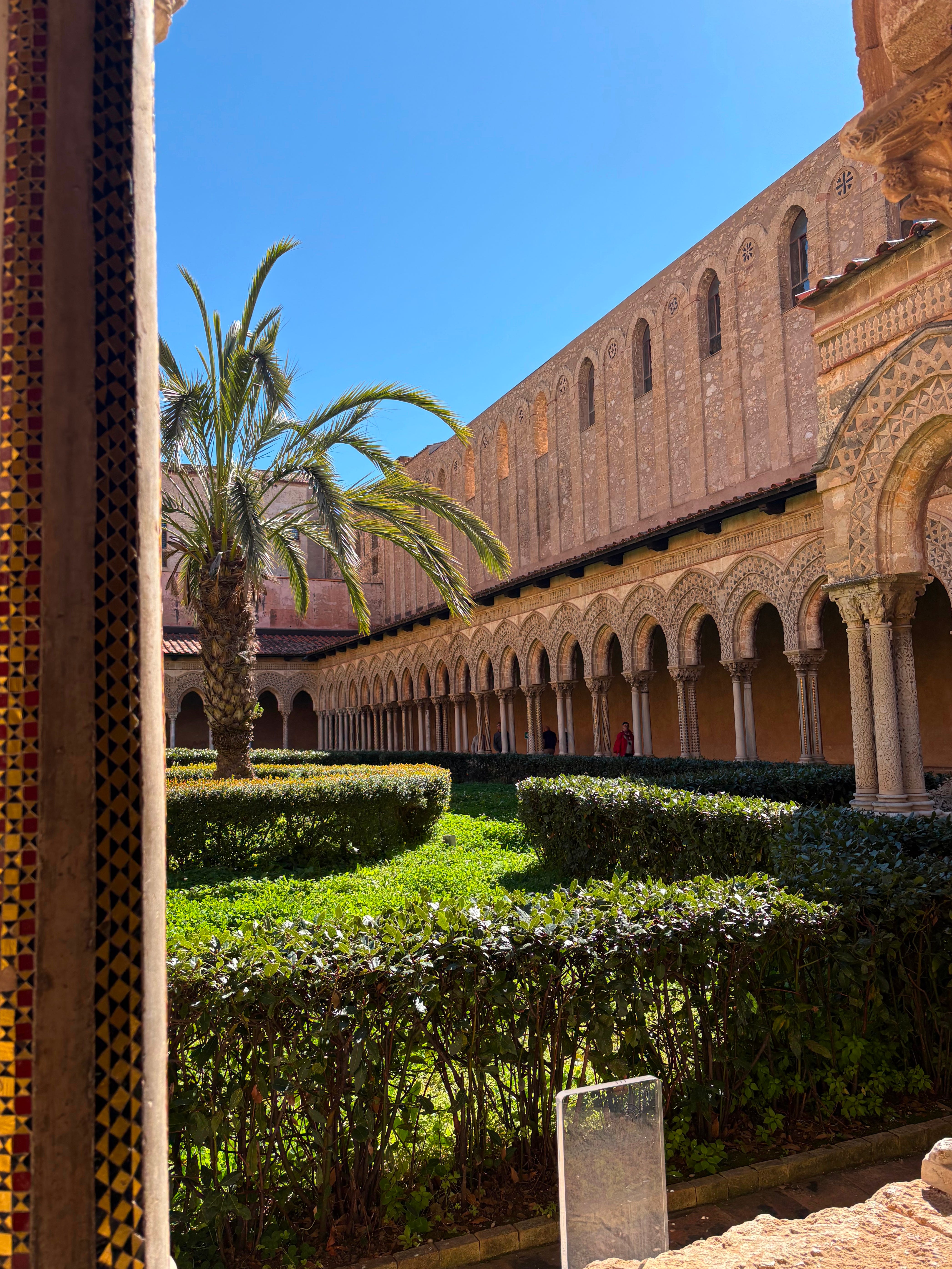
One destination has been the salt pans of Trapani. These I have talked about in passing before. Then I mentioned them as part of the general wealth of the island, and because I’d seen actual wild flamingoes for the first time ever! This was the second time and it was still just as exciting. The tour of the salt pan museum, though, is what caught my attention this time.
Mainly, I found it extremely interesting and this is a place where I love to share those things. I also want to send a special hello to my dad with because he taught me from as long ago as I can remember to pay attention to how things are made, to the labour and knowledge that goes into seemingly simple things and to beauty in everyday craft. There was a lot of that beauty on display, aided by clear blue skies.
Salt: the white gold of Sicily
Salt panning has probably been happening around Trapani since around the 7th century BCE. Local tradition suggests that the Phoenicians started it. By the 12th century CE, it was described as a considerable concern, so even if its exact beginning remains obscure, there is no reason to doubt it had been going on for some time. As we’ll see, the basic conditions that make Trapani such a good place for salt harvesting have always been there. Salt panning started to take on a character that we might call ‘industrial’ from the 13th or 14th century CE and was a major part of the Sicilian economy from the 16th century.
Why salt? It is one of those things that humans just need (we die without it, and so do livestock people rely on) but, as human populations have expended over the last several hundred thousand years, and taken over more and more varied ecosystems, we can’t just expect to have enough of it lying around in our local habitats. Whether mined from under mountains or dried from the sea, salt takes a lot of work, and often extremely hard work, to collect and can make a lot of money for people who then get to distribute it. In South India in the first millennium CE, kings often claimed a monopoly on it. So did the Kingdom of Italy in the 19th century. So have other powers across time and space.
In Sicily, the ‘white gold’ produced on the northwest coast enabled Sicilians to establish trade relationships with the Italian peninsula, but also with places as far afield as Norway, where, for a while in the Early Modern Period, there was a mutually beneficial exchange of salt for codfish. (Portugal was another source of salt for Norway and this explains why salted cod is a common ingredient in both Portuguese and Sicilian food despite both being regions with easy access to their own fresh fish.)
Just the right spot
Trapani is the perfect spot for salt flats due to a few necessary preconditions:
it is by the sea (where there is plenty of salt!)
it sits at a meeting point of two marine currents, which means that there is nearly always wind
it is hot and dry throughout the summer
the shoreline is pretty wide and flat
These conditions are critical because of how the salt is harvested. At the beginning of the process in September and October, water is pumped from the sea. It is moved into a series of pools, each shallower than the next. Over the months that follow, the water is moved from one to another, in each pool becoming saltier as the water evaporates off. Then the remaining, more concentrated, salt water is moved to the next pool which, being shallower, lets even more water evaporate. That is why you need that nice flat shoreline and plenty of sun.
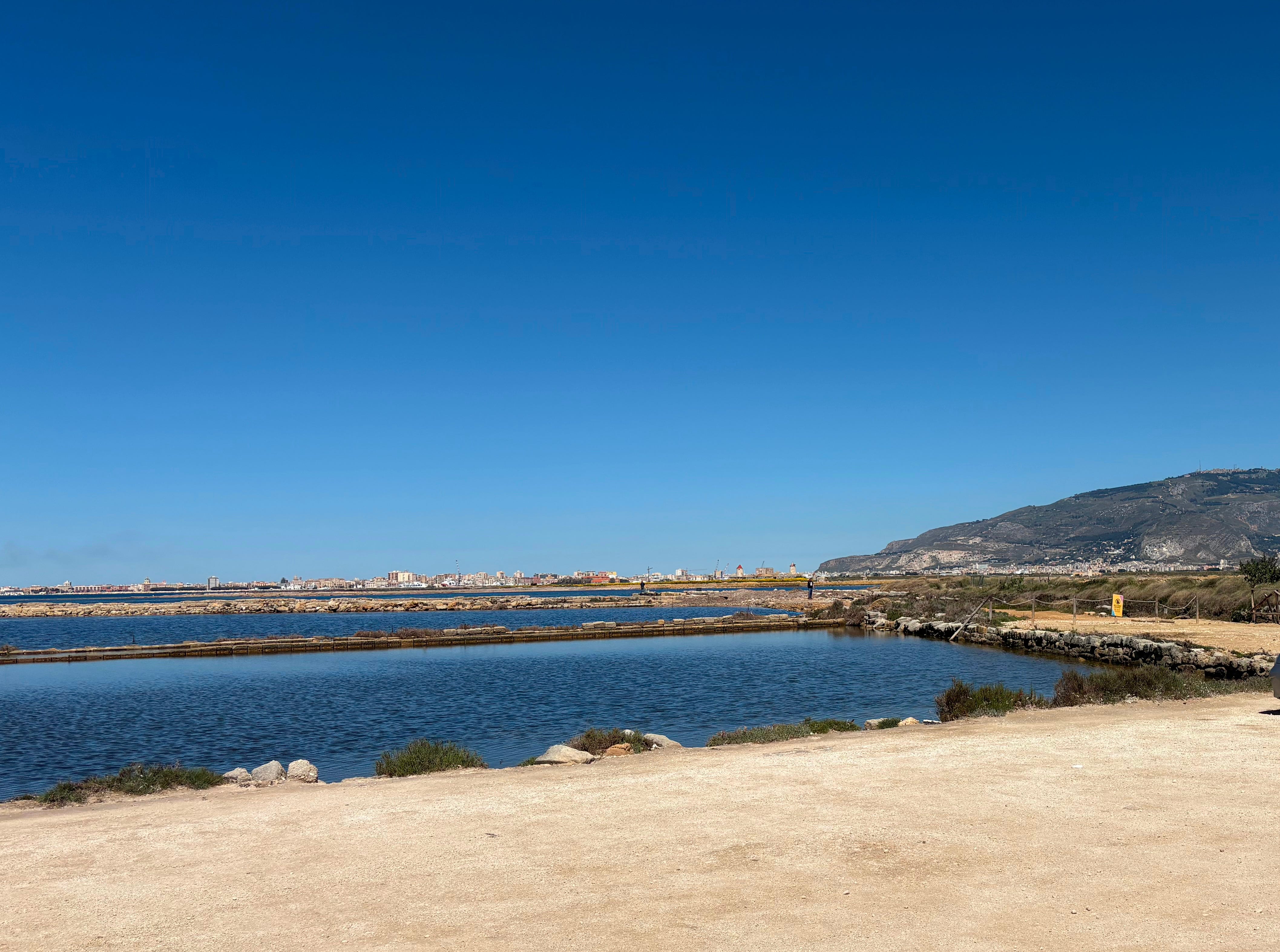
By June, the water is in the final pools and begins to disappear completely, leaving a crust of salt, like ice. When the water dries out completely, super concentrated salty water is added from the second-to-last pool and, as it dries out, the crust thickens. Over 3 months, topping up the water this way, 30-40cm of salt can build up ready for harvesting. It is clean because, over the months of evaporation, the saltier and saltier water kills any bacteria, algae or any other life. It is hard and needs breaking, scooping up, drying and grinding before it is ready to sell.
Hard graft
As the salt museum at Trapani shows, doing all of this before petrol-powered diggers and automated conveyer belts was a combination familiar from a lot of industrial processes, of care, skill and tradition on the one hand, and brutal human exertion on the other. The most experienced, knowledgeable and remunerated people in the process built and maintained machines that eased the human labour where possible. They knew the tides and the winds so that they could direct those machines to capture the changing whims of the weather. And they could manage and direct the process, including keeping track of the piece work of men and boys who got paid per 30kg (66lb) load of salt they delivered from the pools to the drying area.
The least experienced, knowledgeable and remunerated were boys who carried water to the workers to keep them going in the intense summer heat. The majority of people harvesting white gold sat in the middle of this hierarchy. They used handheld cutters for breaking up the salt (like flat shovels with a sharp edge). Then they shovelled the salt into baskets that they carried on their heads, heaving it up a steep slope so that it could be dropped down into a storage area. There the huge piles of salt were covered in terracotta roof tiles to shield it from the rain while still allowing that sea wind to blow through the gaps. This dried the salt over months. Those roof tiles aren’t that heavy (maybe a kilo, or a couple of pounds each) but covering a salt pile involved moving a lot of them!
That was the end of the process for the year: by August or early September, the salt would have been moved from the pans (as the shallow pools are called) to piles. But, of course, September was also the start of the process for the next year. Fresh water would be pumped into the empty pans. While that was evaporating, being moved from one pool to another, the salt gathered and dried the previous year, would be carried inside and ground by the power of the wind, before being bagged up and moved on to market or wherever it was needed. (A lot of salt from Trapani is still sent directly to another town in Sicily, Sciacca, famous for its salted anchovies.)
All of this, as you’ll have noticed, involves a lot of lifting, carrying and, generally, backbreaking labour. It was also labour performed in what sound like hellish conditions. The temperature in Trapani in August can easily exceed 30 degrees centigrade (86 Farenheit). Sunlight from the gleaming white salt flats would have given men something like snow blindness. Salt water and raw salt crystals would have covered their hands and arms and run down their faces from the containers on their heads. Without boots, they would have spent day after scorching summer day sloshing around in the thin layer of highly concentrated salt water that remained under the thick crust they were harvesting. It must have been like bathing in acid under a heat lamp. Skin and eyes suffered.
Technology and craft
The salt pan museum in Trapani does a good job of recognising how hard this work was. It doesn’t shy away or try to brush it under a rug of fuzzy nostalgia. That doesn’t mean there isn’t nostalgia, though. That came, perhaps surprisingly, for the technology and the knowledge systems. A lot of the display includes parts of carefully crafted machines that worked for hundreds of years. Now, a stainless steel equivalent needs replacing every two, we are told. Once, wise elders watched the birds and the clouds for changes in the wind. Now, the internet tells us what the weahter will be, and is always, our guide tells us, wrong.
Some of the nostalgia is about trying to bring the past to life, to draw in visitors and connect through laughter and shared frustrations. Some of it, which I understand deeply, is about wanting people to see that just because life in the past was hard and might seem simple, the people living it were not stupid, uninteresting or uninterested. Technology, ingenuity and expertise are all windows into people thinking, feeling and making their best with the times they were born in, just like all of us.
Take the windmill once used to grind salt at Trapani. The man who watched the winds did so in order to turn the face of the windmill into the breeze and to decide how wide to set the sails. Too little wind and the grinding would slow or stop. Too much and the windmill could tear itself apart. Much depended on his experience, especially because the mill itself was a work of craft and care.
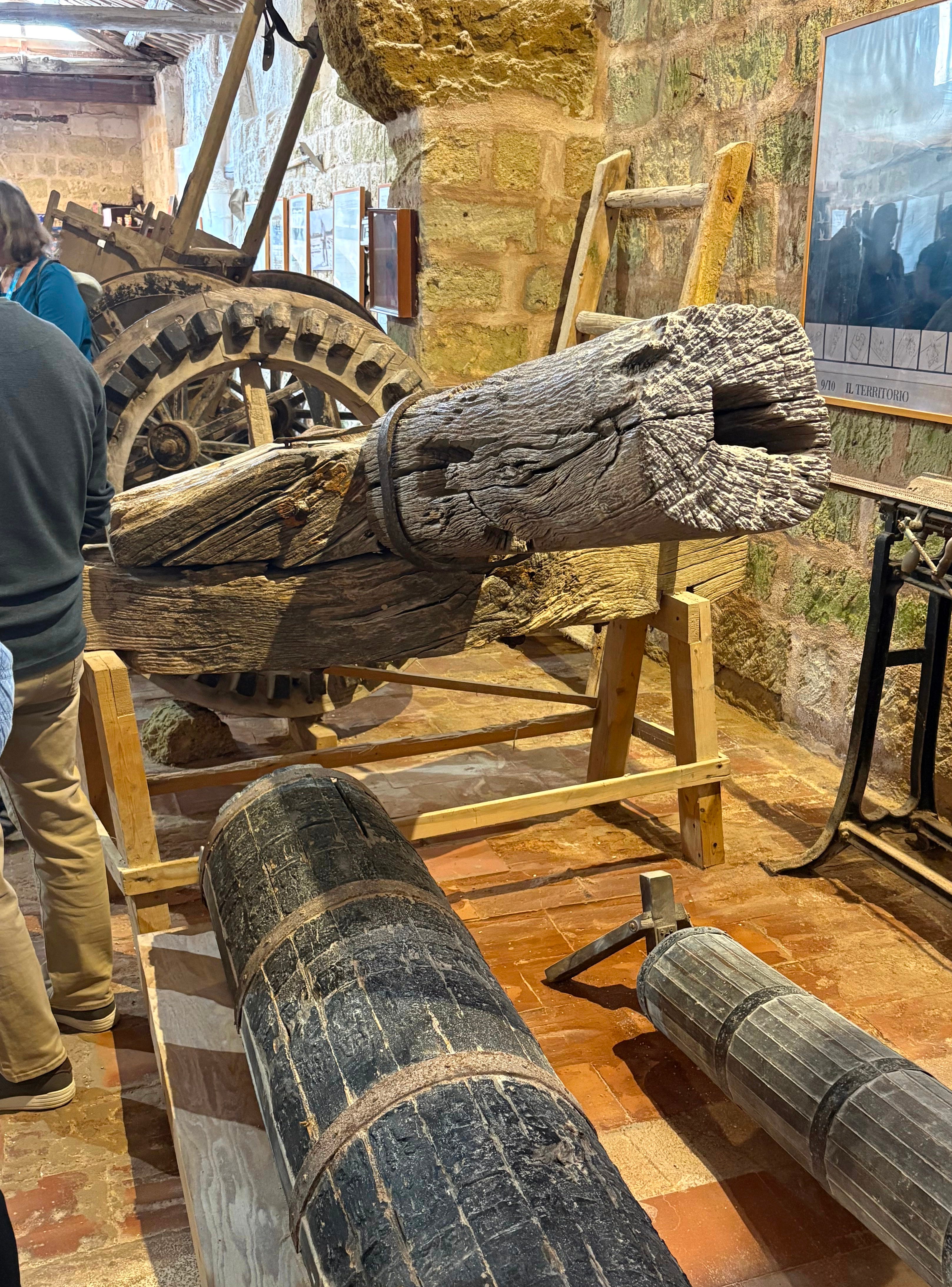
Inside the museum is one of the joints to which windmill sails would have been attached. The wood is dried out and aged but tells a story. The vanes were made of chesnut wood, because it is flexible enough not to break as the wind gusted into the cloth tied to them. They were fitted into a hub of oak, which is the thing at the front of the picture above, angled up from the ground. Oak can withstand high levels of torsion, so wouldn’t tear apart as the chesnut vanes twisted and whipped in the wind. Below the oak came olive wood blocks, which could rub against each other without causing a risk of fire: the tight-grained wood releases oil slowly and steadily, like a natural lubricant. Finally, a toothed cog translates the power of the wind into rotary motion. The wheels of the cog were each made from pear and cherry wood, laminated together to form a compound nicknamed ‘iron wood’, hard enough to withstand each small tooth interlocking with another over and over. Everything was wood because that was what they had but also because, even where metal parts could have been used, the salt would have corroded them.
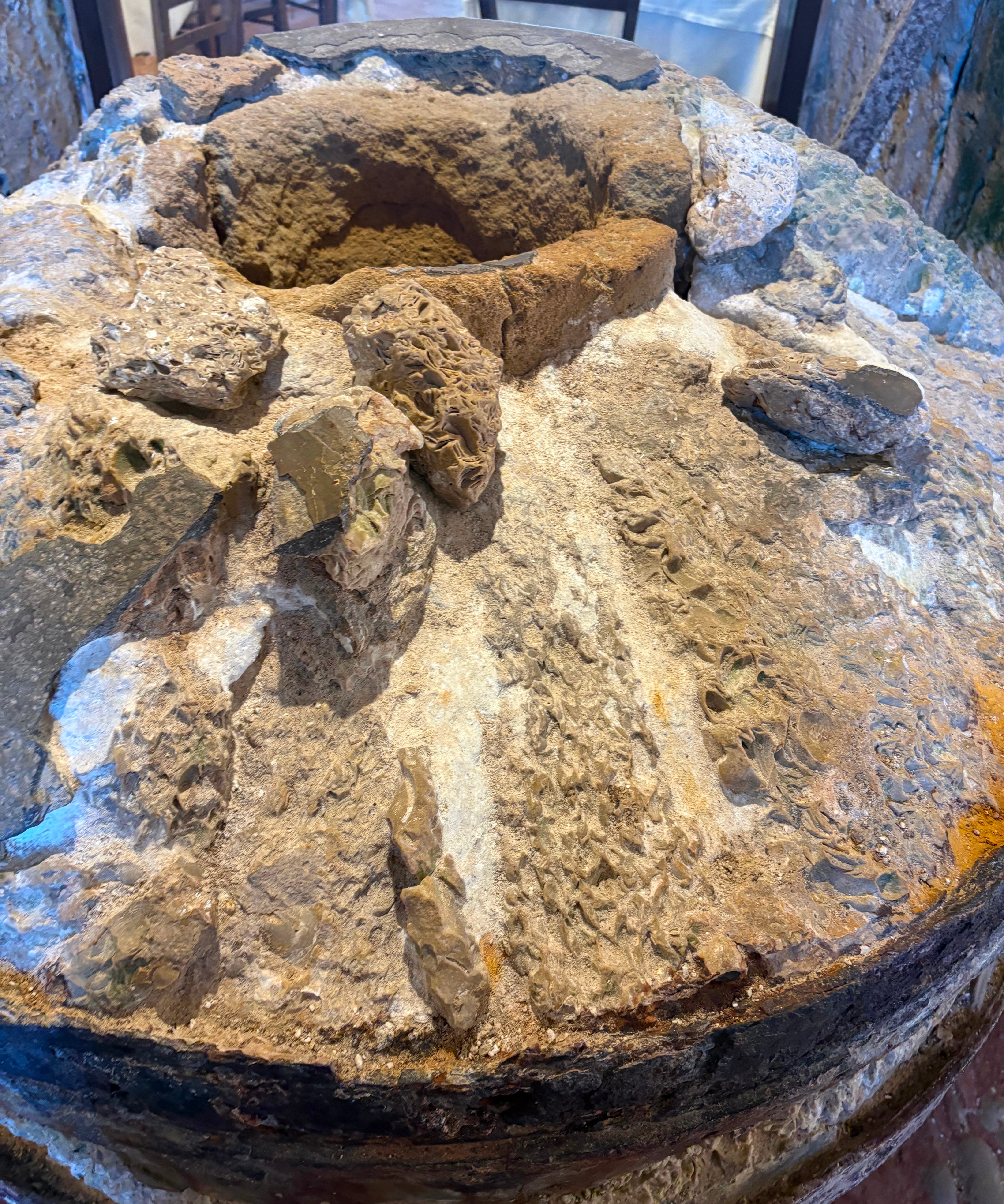
Finally, the stone used for the grinding surface is a local sedimentary rock packed with fossils, which give it a rough, sharp surface. Salt was fed into the grinder so that salt is only ever rubbing against salt - the rock doesn’t do the grinding, which would risk grit getting into the salt - but the roughness of the rock, with all of those little fossils, made sure that the salt kept moving instead of just sliding around with the stone.
For centuries, craft and care were at the centre of how people found a place, earned respect and exercised their talent and intellect in the world. Every choice to make a slightly better windmill was an innovation at some point, a decision to do a bit more work upfront for an easier life later or a chance taken on something that might not work or that didn’t quite work at first. Whoever first looked at the properties of pear and cherry wood and thought about how they could work together was making the same calculations as engineers today working with carbon fibre and steel: what might last a little longer, be a little safer, or a fraction cheaper for the same outcome?
They are also, though, choices rooted in a place and the resources it made available and they changed slowly, giving the impression of timelessness even as things transformed with every generation. Perhaps that is where some of the nostalgia comes from? Perhaps it is control: whatever the outcome, the feeling of working with a lifetime of knowledge or with familiar wood grain and stone gives the impression that we are in charge, whereas a steel machine might simply break or the internet give us the wrong weather forecast. This is largely an illusion. The wise weather watchers would sometimes have gotten it wrong, because weather systems are complicated, and the internet often gets it right. The wooden machines would have broken too, and when they did, weeks or months of work might have been needed to replace them. But whatever the scale of work needed, it was work that could be comprehended within a single community. Is that a comfort?
Or is it the sense of uniqueness, that the technology of our lives, when it was carved out of olive wood and oak, was as unique as each of us and our world? Each windmill might incorporate innovations but at the same time, each one would be just a little different from every other, shaped by hand, managed and repaired with generations of care. Does the nostalgia for old technology come from a sense that it created worlds in which we fitted, rather than one that asks us to fit into its own standardised gaps?
Nostalgia is a curious phenomenon for a historian. Very few of us would ever want to live in the times we study, even if we quite fancy a diving bell of some sort from which we could peer in safety. That doesn’t make me immune. Some of the feeling I had as I stared at the windmill arm was just how much quieter it must have been. I could also imagine the feeling of sharing generations of family life with a machine created from wood of the same soil.
I respect a museum that doesn’t try to gloss over the awful reality of ‘craft’ but that still makes space for the complicated link we create as people with our pasts and our places. It made me think and isn’t that the point?